Welcome: Shenzhen Zhuolida Electronics Co.TD
Language:
 ∷

∷
∷
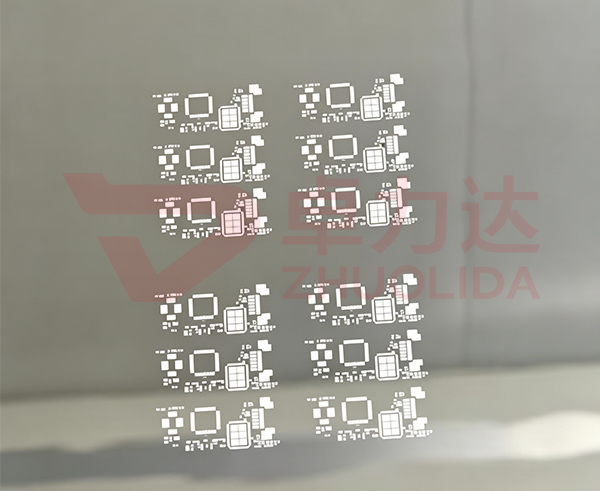
Electroformed microhole mesh clogging re-inspection is the delivery check that runs after cleaning and before packing: it counts blocked holes as a share of the design count and computes the open area ratio (measured flow area over design open area). It is not the same thing as open-area control on the production side — one is the target chased during forming, the other is the result re-checked before delivery. The inspector counts hole by hole across five fields under a 50× microscope, centre plus four edges, half-blocked holes weighted as half, and anything the top view cannot settle goes to the 0.1 MPa flow bench.
Most clogging comes from the cleaning stage. Adhesive residue, polishing fines and drying stains each block their share; a sheet that looks clean goes on the line, airflow drops 8%, and the trail leads back only after the customer stops. Half-blocked holes are worse: a 30 μm bore necked down to 18 μm by residue still reads open from above while the air volume is already wrong. Unclear definitions cause their own fights: 45% open area on the drawing is the design target, 41% measured at re-check is the delivery result, and unless the two numbers sit side by side neither side accepts the other. Batches packed a day after cleaning also face re-clogging — dust pulled in by moisture recovery blocks holes the same way, so that exposure window goes into the record.
Parameter Window
• Aperture tolerance ±3 μm, smallest hole in the microhole zone ≥25 μm; clogging recorded by both hole count and area share
• Delivery basis: open area ratio ≥98% (measured over design), single-hole clogging ≤0.5%
• Flow re-check at 0.1 MPa, air volume within ≤5% of the same-spec reference sample
• Cleaning spec: ultrasonic 40 kHz, 40–60°C, 10–15 min, pure-water rinse then hot-air dry
• Microscope 50× for first pass, 100× for the count, five fields (centre plus four edges) logged hole by hole
• Verdict: clogging above 0.5% goes back for re-clean, past 2 rounds is scrap; a washed-out face is scrap too
Manufacturing Process (8 Steps)
1. Pre-delivery cleaning — ultrasonic 40 kHz, 40–60°C, 10–15 min, lifting adhesive residue and fingerprints.
2. Rinse and dry — three-stage pure-water rinse, hot-air dry at 60–80°C, water stains ruled out as false clogs.
3. Visual first pass — 50× microscope sweeps five fields, obvious foreign matter pulled out and logged separately.
4. Clogging re-check — 100× counts blocked and half-blocked holes field by field, share computed on the spot.
5. Open area re-computation — vision system measures flow area against design open area for the ratio.
6. Flow re-check — air volume at 0.1 MPa compared with the same-spec reference, deviation ≤5%.
7. Verdict routing — clogging ≤0.5% releases; out of band re-cleans, and 2 rounds still out is scrap.
8. Data filing — clogging rate, open area and flow filed on one sheet, queryable per piece.
Core Advantages
1. The delivery basis stands as its own line — design open area and re-check result in two columns, neither speaking for the other.
2. Top-view counting plus flow double-checks the half-blocked hole: weighted in the count, exposed on the bench.
3. Cleaning parameters quantified at 40 kHz and 10–15 min, so any re-check result traces to a real process step.
4. Rework and scrap lines drawn up front — 0.5%, 2 rounds — leaving no room for endless washing.
5. Five fields cover centre and edges, so an uneven clogging pattern still shows up.
6. Three data sets on one filing sheet — clogging rate, open area and air volume corroborate each other.
Typical Applications
• Gas filtration microhole mesh, where blocked holes push pressure drop straight up
• Precision liquid filter sheets, where half-blocked holes shift the cut point
• Spinneret backing plates, where one blocked hole breaks a filament
• Flow-distribution mesh, where uneven openings skew the distribution
• Medical nebuliser and inhaler mesh, where clogging changes delivered dose
• Export orders delivered after cleaning, reported on this basis
Design and Selection Notes
1. Write the two rulers apart. Production open area is the forming target; the delivery re-check is the clogging basis, each on its own drawing line.
2. List half-blocked holes on their own. Open from above is not flow; back it with 100× side views or the flow method.
3. Cleaning parameters go on the process card — 40 kHz, 40–60°C, 10–15 min is what makes re-check data comparable.
4. Longer is not automatically better; past 20 min of ultrasonics damages the membrane face and can drive debris deeper into the bore.
5. If airflow deviation passes 5% on two sheets in a row, go back and re-check cleaning and drying before touching the aperture drawing.
6. Agree the scrap line early. Two rounds still out and the piece is scrap; repeated washing only roughens the mesh face.
7. Keep reference samples from the same batch under the same conditions and re-check at 3 months for dust-driven re-clogging.
On the bench, electroformed microhole mesh clogging re-inspection is two moves: count holes, then run flow. At 100× the inspector counts five fields — 3 blocked, 2 half-blocked — a hole share of 0.4%, released at ≤0.5%; on the 0.1 MPa bench the air volume sits 3% off the reference, and only when both bases agree does the sheet get signed. The half-blocked hole is what this check is about: open from above, narrowed for flow, weighted in the count and exposed on the bench. Electroformed microhole mesh clogging re-inspection and open-area control belong on separate contract lines: 45% design is the forming target, 41% measured is the delivery result, and ≥98% open area ratio is the release line — three numbers, each governing its own stretch. If airflow deviation passes 5% on two sheets in a row, go back and re-check cleaning and drying instead of revising the aperture drawing. Rework has a ceiling: 2 rounds still past 0.5% is scrap, and a face washed out by cleaning cannot ship either. For orders delivered after cleaning, put the ultrasonic parameters, field count, half-hole weighting rule and 3-month re-check into the acceptance clause together. What ships is the re-check record with clogging ≤0.5%, airflow deviation ≤5% and all three data sets on one queryable sheet.
Contact:赖先生
Phone:+86 18938693450
Tel:0755-2708-8292
Email:yw9@zldsmt.com
Add:深圳市宝安区福永镇新和村福园一路华发工业园A3栋
 Zhuolida