Welcome: Shenzhen Zhuolida Electronics Co.TD
Language:
 ∷
∷

∷
∷
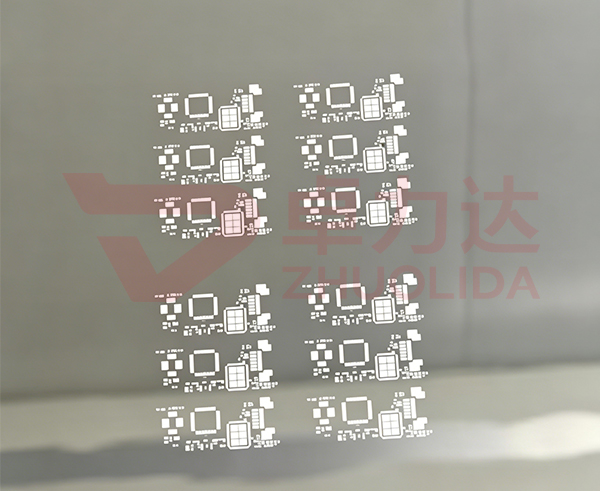
MEMS chips integrate specialized microstructures such as microsensors, micro-mechanical cantilevers, pressure chambers, and microchannels. Unlike conventional logic and power chips, the packaging and testing stages impose extremely stringent requirements on fixture templates in terms of micro-area clearance, alignment accuracy, board surface cleanliness, and low-stress characteristics. As core fixtures for chip electrical testing, wafer sorting, and packaging alignment, MEMS chip packaging wafer test templates enable precise probe guidance, protection of chip microstructures, and isolation of redundant areas. This helps prevent production defects such as probe damage to micro-mechanical structures, test signal drift, and die breakage. The fabrication of MEMS chip packaging wafer test templates relies on micro-nano lithography, differential chemical etching, and post-processing in a cleanroom environment. These processes accommodate the non-standard structural requirements of MEMS pressure, acoustic, and inertial sensor chips, supporting both small-batch R&D prototyping and large-scale production on wafer lines. Leveraging extensive experience in semiconductor microfabrication, manufacturers of MEMS chip packaging wafer test templates have optimized micro-area etching and irregular slot-cutting processes. They have overcome technical challenges in fabricating MEMS-specific avoidance slots, ultra-fine alignment holes, and ultra-thin substrate surfaces, thereby meeting the full-process requirements for advanced MEMS chip packaging and wafer testing.
The entire production process employs a Class 100 semiconductor cleanroom closed-loop system, comprising nine major steps: simulation and verification of operating conditions, selection of specialized low-stress substrates, ultra-clean surface pretreatment, micro/nano-pattern photolithography transfer, zone-specific differential etching, dust-free demolding and micro-hole purification, microstructure functional modification, full-scale simulated on-machine quality inspection, and anti-static vacuum packaging. The entire process is maintained under constant temperature and humidity control to eliminate the impact of dust, substrate stress, and micro-burrs on template performance. MEMS chip packaging and wafer testing templates utilize a stress-free etching process, supporting three types of substrate applications: ultra-thin MEMS wafers, bumped wafers, and cavity wafers. Production accommodates both universal templates for entire wafers and localized custom templates. The manufacturing of MEMS chip packaging wafer test templates categorizes process parameters into three tiers: consumer-grade sensors, industrial-grade MEMS, and automotive-grade MEMS. This approach distinguishes between standard micro-hole processing and specialized processing for irregular-shaped avoidance grooves. The manufacturer maintains a dedicated MEMS process database, adjusting etching rates, exposure parameters, and surface treatment solutions based on the microstructures of different chip types to ensure template compatibility with equipment and batch-to-batch consistency.
Demand simulation and process design are the primary core processes for the mass production of MEMS chip packaging wafer test templates. Engineers conduct simulation modeling based on MEMS wafer dimensions, chip micro-cantilever layouts, cavity clearance zones, test probe locations, bump spacing, and temperature-varying test conditions. They calculate micro-area side-etch compensation and board stress distribution, and plan the layout of test microvias, irregular clearance grooves, and equipment positioning reference holes to prevent compression of the chip’s micro-mechanical components during template bonding. For inertial sensors and acoustic MEMS chips, the board’s open-area clearance structures are optimized to preserve exposed space in the chip’s functional zones, while simultaneously optimizing probe hole taper to enhance high-frequency test stability. After the drawings undergo dual-dimensional verification by both packaging and testing teams, the production plan is finalized, aligning the design phase with the dedicated MEMS chip manufacturing process logic. The fabrication of MEMS chip packaging wafer test templates allows for the simultaneous integrated layout design of test holes, functional clearance slots, and positioning holes. Manufacturers of MEMS chip packaging wafer test templates leverage extensive design experience to shorten the iteration and production cycle for new product solutions.
Substrate selection and ultra-clean surface pretreatment lay the foundation for the quality of finished MEMS chip packaging wafer test templates. The manufacturing process utilizes ultra-thin nickel-based alloys and precision stainless steel substrates that are low in internal stress, corrosion-resistant, and temperature-stable. Strict control is maintained over substrate grain uniformity and surface flatness, and raw materials with latent stress, surface oxidation, or fine scratches are rejected to prevent deformation and damage to MEMS microstructures after the template is bonded to the wafer. The pretreatment process consists of four sequential steps: alkaline dust-free degreasing, multi-stage ultra-pure water rinsing, plasma surface activation, and micro-level leveling etching. This thoroughly removes organic impurities and oxide layers from the substrate surface, enhances the adhesion of micro- and nano-scale photoresists, and eliminates defects such as localized delamination and etching defects. For ultra-thin template substrates below 0.03 mm, a low-temperature, constant-temperature stress-relief process is added to release the substrate’s inherent stress. The processing of MEMS chip packaging and wafer testing templates adheres to MEMS-specific ultra-high-purity cleaning standards, which far exceed the control requirements for standard chip templates. Manufacturers of MEMS chip packaging and wafer testing templates have refined and categorized their pretreatment processes; automotive-grade MEMS supporting templates undergo a dual-activation cleaning process.
Micro- and nano-scale laser lithography and pattern transfer determine the precision of microstructure formation in MEMS chip packaging wafer test templates. Ultra-thin dry film is uniformly laminated in a Class 100 cleanroom. Utilizing laser direct-write micro-nano exposure equipment, precise alignment and exposure are achieved for probe microvias, irregular clearance grooves, and positioning holes. For composite patterns with extreme variations in density, a zone-specific energy-controlled exposure process is employed to balance the development rates of dense probe holes and large-sized clearance grooves, thereby preventing pattern defects and jagged edges in micro-regions. Utilizing a constant-temperature slow-development process, we reproduce micron-level precision patterns to ensure smooth clearance groove contours and neat probe hole edges, thereby preventing scratches on the MEMS chip’s surface coating and micro-mechanical structures. MEMS chip packaging wafer test template processing precisely replicates non-standard irregular clearance patterns to accommodate various irregular MEMS die layouts. Manufacturers of MEMS chip packaging wafer test templates have upgraded their micro-nano alignment equipment, controlling overall alignment errors within the micrometer range.
Zone-controlled chemical etching is the core forming process in the fabrication of MEMS chip packaging wafer test templates. The patterned workpiece is placed in a sealed, corrosion-resistant etching chamber. A specialized etching solution for minimizing side etching is formulated based on the substrate’s properties. A dual-sided, segmented variable-speed spraying mode is employed to differentiate etching rates for standard probe holes and large-sized clearance grooves, thereby mitigating side etching issues in microstructure areas and ensuring vertical, smooth hole and groove walls. The entire process involves no mechanical compression or cutting tools, resulting in no residual stress in the templates. This eliminates warping of the board surface and edge burrs, perfectly meeting the requirements for fragile MEMS micro-mechanical components. For templates with integrated shallow and deep composite structures, an intermittent step-by-step etching process is employed to simultaneously complete the integrated formation of shallow test holes and deep avoidance grooves. The fabrication of MEMS chip packaging wafer test templates eliminates defects caused by hard machining, protecting both the bare wafer and its surface microstructures. Manufacturers of MEMS chip packaging wafer test templates have optimized eco-friendly, low-etch formulations that balance forming precision with workshop environmental production standards.
Cleanroom film removal and purification, along with functional surface modification, enhance the durability of MEMS chip packaging wafer test templates. After etching, residual dry film is removed using a dedicated, dust-free stripping agent. Through micro-pore ultrasonic cleaning to dislodge impurities, ultrapure water circulation rinsing, and vacuum low-temperature drying, chemical residues and metal micro-debris are thoroughly removed from the interior of micro-pores and recesses, preventing contamination of the MEMS chip cavity by falling impurities. Based on chip testing conditions, we perform anti-static passivation, micro-polishing, and anti-adhesion coating treatments to reduce probe friction wear and prevent electrostatic discharge from damaging MEMS microcircuits. The surface roughness of MEMS chip packaging wafer test templates is adjusted as needed to meet wafer bonding and sealing requirements. Manufacturers of MEMS chip packaging wafer test templates integrate etching, cleaning, and surface modification processes to shorten custom delivery cycles.
Multi-dimensional simulation quality inspection and cleanroom packaging serve as the final quality control stage for MEMS chip packaging wafer test templates before shipment. Dimensional, flatness, and internal stress inspections are conducted using 3D profilometers, micro-hole detectors, and stress testers. Additionally, wafer test conditions are replicated to simulate on-machine bonding and probe pressure tests, verifying clearance, alignment accuracy, and sealing performance. Qualified products undergo anti-static vacuum sealing in a cleanroom environment to prevent oxidation caused by dust and moisture during storage and transportation. A dedicated quality inspection standard is established for each MEMS chip packaging wafer test template, with item-by-item acceptance based on MEMS packaging drawings. Manufacturers of MEMS chip packaging wafer test templates implement a full-process traceability system to ensure consistent performance across batch templates.
MEMS chip packaging wafer test templates are widely used in the three major mainstream chip packaging and testing scenarios: acoustic MEMS, automotive inertial MEMS, and industrial pressure MEMS. The manufacturing of these templates continuously optimizes processes to align with the trends toward miniaturization and structural iteration in MEMS chips. Manufacturers of MEMS chip packaging wafer test templates specialize in micro- and nano-precision machining, helping to improve quality and efficiency in the MEMS semiconductor packaging and testing industry.
Application Case for Acoustic MEMS Microphone Chips: These chips feature built-in thin-film diaphragms that are highly susceptible to damage from pressure, requiring strict clearance specifications for test fixtures. Custom MEMS chip packaging wafer test fixtures are designed with large-area irregular clearance grooves to protect the thin-film structure. During manufacturing, the flatness of the fixture surface is strictly controlled to prevent localized compression of the chip’s functional areas. Manufacturers of MEMS chip packaging wafer test templates optimize low-stress manufacturing processes to accommodate high-volume testing of acoustic chip wafers.
Application Case: Automotive Inertial MEMS Sensor Chips: Automotive-grade chips operate under complex high-low temperature cycling conditions, requiring test templates that are temperature-resistant and resistant to deformation. MEMS chip packaging wafer test templates utilize temperature-resistant substrates combined with reinforced structural designs. The manufacturing process for these templates optimizes coating techniques to enhance electrostatic protection and temperature resistance. Manufacturers adhere to automotive-grade quality control systems to meet the stringent packaging and testing standards for automotive chips.
Industrial pressure MEMS chip application case: Since the chips feature pressure-sensing chambers, the templates must precisely avoid the chamber locations. MEMS chip packaging wafer test templates precisely align with the chamber layout and feature custom cutout structures. The manufacturing process employs micro-controlled etching tolerances to improve wafer stacking and bonding accuracy. Manufacturers optimize zone-specific etching processes to meet the long-term mass production testing requirements of industrial MEMS chips.
Overall, MEMS chip packaging wafer test templates are indispensable precision fixtures for the packaging and testing of specialized micro-electro-mechanical systems (MEMS) chips. The manufacturing of these templates relies on micro- and nano-precision etching processes to address the limitations of conventional templates. Manufacturers of MEMS chip packaging wafer test templates focus on iterating processes to resolve MEMS-specific manufacturing challenges, thereby comprehensively empowering the high-quality development of China’s MEMS chip packaging and testing industry.
Contact:赖先生
Phone:+86 18938693450
Tel:0755-2708-8292
Email:yw9@zldsmt.com
Add:深圳市宝安区福永镇新和村福园一路华发工业园A3栋
 Zhuolida