Welcome: Shenzhen Zhuolida Electronics Co.TD
Language:
 ∷

∷
∷
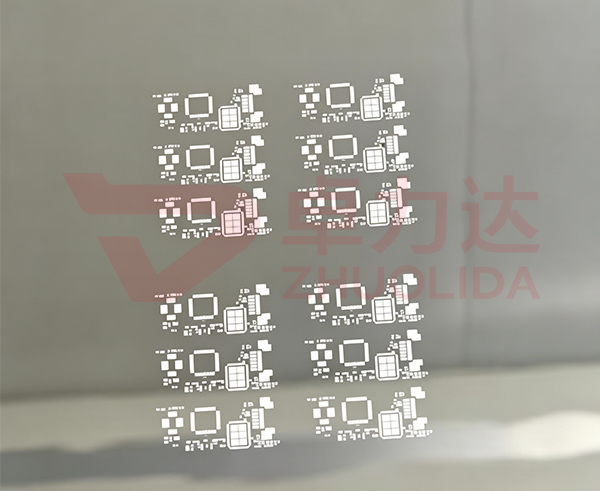
Electroformed aperture blade coating adhesion is about whether the blackened matte film grips the nickel substrate: scribe a grid, press a tape strip, peel it, and see what leaves. Two instruments run together, the cross-hatch test on the GB/T 9286 convention with 1 mm pitch, a 6x6 grid and a single blade cut through to substrate, and the tape test with 25 mm wide 3M 610 pressed flat for 90 s then peeled fast at 60°. Both are rated 0 to 5, and only ≤1 passes internally. The 0.5–2 μm blackening layer carries no load itself; all its grip comes from pre-treatment activation. Once adhesion loosens, a few wipes with a cleanroom cloth expose bare nickel and stray light climbs right away.
Three symptoms on the floor point at adhesion trouble. The first is whitening after wiping: 30 passes with a lint-free cloth soaked in 75% ethanol reveal a nickel ring at the matte edge, reflectance rises from 5% to 12%, and the laser channel fills with ghost images. The second is peeling after thermal cycling, ten rounds between −20 °C and 80 °C lifting the film edge so the tape test pulls off whole patches. The third is incoming inspection that only asks how black it looks, with the cross-hatch tool present but the convention loose: a 1 mm pitch and a 2 mm pitch differ by a full grade, so parts passed in-house come back from the customer. Together these show what electroformed aperture blade coating adhesion lacks: method, criteria and durability as a set.
Parameter Window
• Blackening film 0.5–2 μm, five points per blade on XRF or ellipsometer, range ≤0.4 μm.
• Cross-hatch: 1 mm pitch, 6x6 grid, single blade cut to substrate, grade ≤1 for release.
• Tape test: 25 mm wide 3M 610, pressed 90 s, peeled at 60°, detached area ≤5%.
• Three durability gates: 10 cycles between −20 and 80 °C, 48 h at 40 °C/95%RH, 30 ethanol wipes.
• Reflectance at first test ≤5% over 400–700 nm, rise after the three gates ≤1 percentage point.
• Pre-treatment activation: acid dip 30–60 s, water film unbroken for 30 s before the blackening bath.
Manufacturing Process (8 Steps)
1. Blade forming — electroformed aperture blades released at 20 μm rib width, edge burrs held to Rmax ≤0.4 μm first.
2. Degrease and activate — alkaline clean plus acid activation 30–60 s, water film unbroken for 30 s.
3. Pure water rinse — rinsed at conductivity ≤5 μs/cm so no residual acid reaches the blackening bath.
4. Blackening — bath at 60±2 °C for 3–5 min, stopped once the film reaches 0.5–2 μm.
5. Sealing and drying — 20 min at 80 °C closes the film pores, and no powder rubs off by hand.
6. Film thickness re-measurement — five points per blade, range within 0.4 μm, failures return to pre-treatment.
7. Adhesion double check — cross-hatch 6x6 and tape peel at 60° both recorded as grades on the card.
8. Durability sampling — three blades through thermal, humidity and wipe gates, reflectance re-measured before the report.
Core Advantages
1. Electroformed aperture blade coating adhesion is judged by both scratch and tape with every parameter fixed, so the 1 mm versus 2 mm argument is over.
2. The three durability gates run before shipment, and the customer's 30 ethanol wipes reproduce exactly what is printed on the card.
3. The five-point film map is tied to the adhesion grade, so thin-edge whitening is stopped inside the plant.
4. Reflectance ≤5% and rise ≤1% turn looks black enough into a reading, without relying on the inspector's eye.
5. The water-film-for-30-s rule cut the film rejection rate from 8% to under 1%.
6. Three blades per lot go through thermal cycling, so a sample exists when a return is disputed.
Typical Applications
1. Aperture blades in laser scanners, where the matte face takes long exposure to the beam edge and weak film raises stray light.
2. Spectrometer entrance slits and stray-light traps, where any flaking on the inner wall destroys signal-to-noise.
3. Small apertures in medical endoscope optics, wiped daily with alcohol disinfection.
4. Matte ribs inside industrial camera barrels, 20 μm wide, where an over-thick film closes the opening and drops image contrast.
5. Optics for outdoor and low-temperature duty, where −20 to 80 °C cycling is the baseline.
6. Export orders needing adhesion and durability reports, with cross-hatch photographs shipped with the goods.
Design and Selection Notes
1. Fix the test method before the grade; without the method on the drawing, two grade 1 results do not mean the same thing.
2. Thicker film is not automatically more durable. Past 2 μm internal stress rises and thermal cycling peels it sooner.
3. If tape detachment exceeds 5% on two lots running, go back to the acid dip time and bath temperature records.
4. Tape model and peel angle belong on the inspection card; peeling at 60° and at 90° can differ by two grades.
5. Nickel substrate and blackening chemistry are validated on a small batch first, and a bath supplier change means the three gates again.
6. Wipe testing standardises on lint-free cloth with 75% ethanol, not whatever each line mixes up.
7. Prototype lots clear 10 thermal cycles before production; a lot that sheds film is not pushed through.
Electroformed aperture blade coating adhesion lands on two records: the cross-hatch grade and how much the tape lifts. Cross-hatch at 1 mm on a 6x6 grid, 25 mm tape peeled at 60°, detachment ≤5%, then 10 thermal cycles, 48 h humidity and 30 ethanol wipes with reflectance rise ≤1 point. Write those into the card and the inspector works to a conclusion instead of arguing over how black it looks. What ruins aperture blackening film re-measurement is a loose convention: the same grade 1 at 1 mm and at 2 mm pitch is a full grade apart, and a shift change turns it into a mess. For customers with hard electroformed aperture coating durability requirements, attach the method, the criteria and the three gates with the cross-hatch photographs, and acceptance becomes a point-by-point check with far fewer disputes.
Contact:赖先生
Phone:+86 18938693450
Tel:0755-2708-8292
Email:yw9@zldsmt.com
Add:深圳市宝安区福永镇新和村福园一路华发工业园A3栋
 Zhuolida