Welcome: Shenzhen Zhuolida Electronics Co.TD
Language:
 ∷

∷
∷
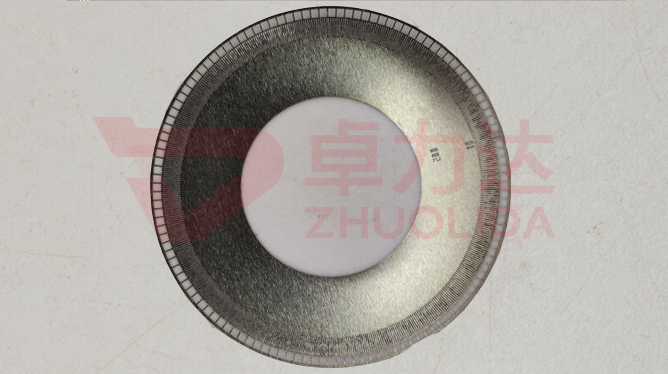
Encoder code disc thermal drift compensation means that when temperature moves, track pitch expands or contracts with it and the output phase wanders, so the drift has to be measured and then corrected out. The linear expansion coefficient of the nickel-cobalt disc is taken from in-house substrate measurement at 13.8×10⁻⁶/°C over 20–80 °C, not from an industry average. Track pitch is 50 μm±0.5 μm, 3600 tracks around a 314.2 mm pitch circle; from 20 °C to 70 °C the circumference grows 0.217 mm, which works out to 0.06 μm per track and 0.25° of accumulated phase. The fix is an NTC on the back of the disc and a lookup table in the decoder, holding residual error inside 0.02°.
Thermal drift on the line usually shows up in three shapes. The first is calibrate-and-ship: zero set on the floor at 28 °C, then the cabinet runs at 45 °C at midday and the absolute reading shifts 0.2°, the customer blames mounting eccentricity, and correcting eccentricity swings it back again. The second is pitch expansion left out of the interpolation table: interpolation built on the 50 μm nominal sees the accumulated circumference change and creep error climbs from 0.01° to 0.08°. The third is a thin temperature set, drawing a compensation curve from 20 °C and 60 °C alone, so the bump near 35 °C goes unattended. All three point at one gap in encoder code disc thermal drift compensation: no temperature points, no residual target, no re-measurement procedure.
Parameter Window
• Expansion coefficient taken as in-house measured 13.8×10⁻⁶/°C over 20–80 °C, with incoming lots accepted only within ±0.3×10⁻⁶/°C.
• Track pitch 50 μm±0.5 μm, reference temperature fixed at 23±2 °C, all pitch re-measurement done in the temperature room.
• Six temperature points at −20/20/35/50/65/80 °C, soaked 2 h each, run on heating and on cooling to record hysteresis.
• Cumulative full-revolution phase drift ≤0.25° from 20 to 70 °C, residual after compensation ≤0.02°, nothing worse ships.
• NTC mounted on the disc back at one fixed 25 mm radius, sensing lag ≤30 s, never on the bracket.
• Thin discs of φ120 mm at 0.10–0.15 mm thickness are clamped at 0.2 N·m maximum to avoid added stress.
Manufacturing Process (8 Steps)
1. Incoming material — expansion coefficient sampled per nickel-cobalt coil lot and recorded on the heat number card.
2. Coating and exposure — LDI writes the tracks at 8 μm/8 μm resolution, pitch bias applied at 23 °C.
3. Development — time graded for 50 μm fine tracks, undercut held within 0.3 μm.
4. Electroforming — current density 1–4 A/dm², deposit held at 30 μm across the disc to keep stress low.
5. Stripping and levelling — lifted from a substrate corner at a shallow angle, rolled flat, then pitch checked around the track.
6. Low-temperature anneal — 2 h at 120–150 °C relaxes deposit stress so clamping does not shrink the disc again.
7. Drift calibration — six points run up and down, full-revolution phase recorded, linear and quadratic terms fitted.
8. Outgoing re-measurement — three discs taken to −20 °C and 80 °C; anything past 0.02° residual holds the whole lot.
Core Advantages
1. The expansion coefficient is measured in-house, so the table behind encoder code disc thermal drift compensation is not an industry average copied from a handbook.
2. The six-point curve covers mid-range temperatures, and the linear term absorbs most of the bulge near 35 °C.
3. Residual after compensation ≤0.02° sits on the outgoing card, so the customer checks one number.
4. Pitch re-measurement is fixed at 23±2 °C, so two lots can be compared without conversion.
5. Both heating and cooling runs are recorded, and only discs with hysteresis inside 0.01° reach assembly.
6. Three discs per lot go through extreme temperature, so a batch problem can be traced back to the heat number.
Typical Applications
1. Servo motor encoders, where the cabinet routinely runs from 25 °C to 60 °C.
2. Absolute encoders for lifts and cranes, facing outdoor −20 °C winters.
3. Machine tool spindle encoders, where zero shift after 2 h warm-up must stay inside 0.02°.
4. Discs mounted on aluminium brackets, whose expansion has to be stacked into the compensation table.
5. Robot joint modules, small cavities that climb 30–40 °C under continuous duty.
6. Export orders requiring a thermal drift re-measurement report, with the six-point curve shipped alongside.
Design and Selection Notes
1. Fix the residual target before discussing the temperature range; 0.02° written into the contract beats the words low thermal drift.
2. Finer temperature tables are not automatically better. An eight-segment table and a linear fit differ by less than 0.01° across 50 °C, so calibration hours are wasted there.
3. If thermal drift re-measurement residual exceeds 0.02° on two lots running, go back to the anneal record and the material heat numbers.
4. Sensor position belongs on the assembly drawing; on the disc versus on the bracket is a 30 s difference in lag.
5. Unify the pitch reference temperature at 23±2 °C; a drawing without a reference temperature has no real tolerance.
6. Thin 0.10 mm discs are clamped at 0.2 N·m maximum, since over-tightening stacks stress into the pitch.
7. Prototype runs first measure heating-cooling hysteresis; a disc with wide hysteresis cannot be rescued by a quadratic term.
Encoder code disc thermal drift compensation at bottom is thermal expansion bookkeeping: work out the account, then correct it. The 13.8×10⁻⁶/°C is measured in-house, the six temperature points are run up and down, and the residual is 0.02°; with those three numbers in place, readings hold even in a 45 °C cabinet at the customer site. The inspector tapes an NTC to the disc in the temperature room, walks the cycle from −20 °C to 80 °C, fits the phase curve into the decoder, and sends anything past 0.02° back for review. Code disc pitch thermal expansion correction is not an optional extra; every wide-temperature application has to clear it. For orders with hard electroformed disc thermal drift re-measurement requirements, ship the six-point data, the hysteresis and the heat numbers, and assembly simply corrects by the table.
Contact:赖先生
Phone:+86 18938693450
Tel:0755-2708-8292
Email:yw9@zldsmt.com
Add:深圳市宝安区福永镇新和村福园一路华发工业园A3栋
 Zhuolida