Welcome: Shenzhen Zhuolida Electronics Co.TD
Language:
 ∷

∷
∷
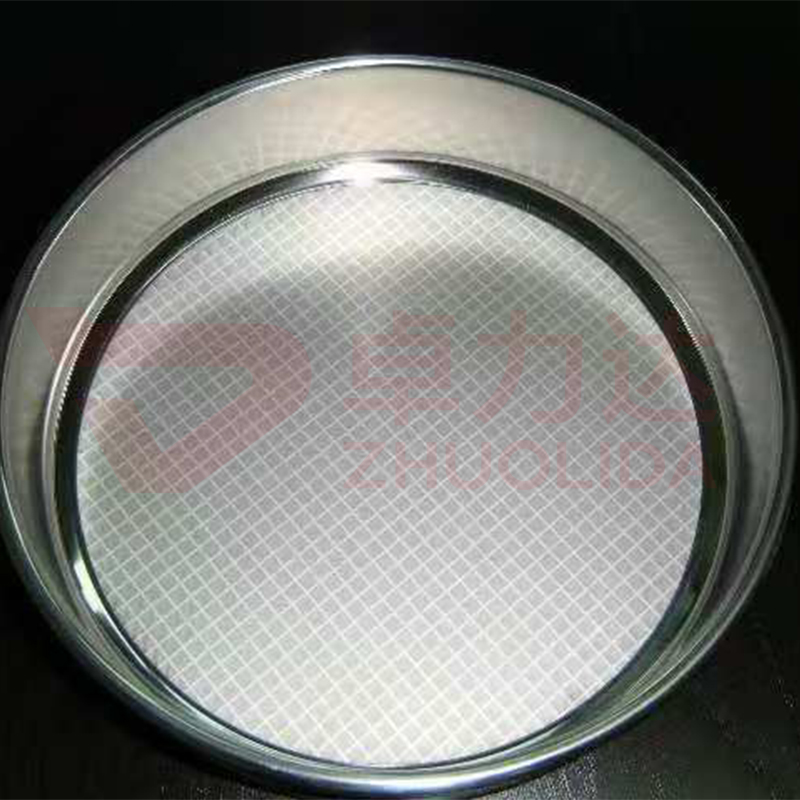
Electroformed screen pressure drop curve re-measurement means mounting the screen on a test rig, tracking how the differential pressure across it moves with flow, and overlaying that on the new-screen baseline. The medium is fixed at 23±2 °C deionized water, flow is given in five steps across 0.5–2.0 L/(min·cm²), pressure taps sit symmetrically 10 mm off the mesh on both sides, and the gauge covers 0–40 kPa at ±0.5% accuracy. A curve climbing to the right means the pores are blocking; one sagging usually means enlarged holes or a deformed mesh. This is a third account alongside open area and aperture tolerance, which describe geometry while this one describes operation. Hold each of the five steps 3 min and a full curve is ready in 20 min.
Pressure drop problems on the floor tend to appear in three ways. The first is unnoticed flow decay: pump speed unchanged, a line running 18 L/min on day shift falls to 15 L/min at night, the operator blames the pump, and the mesh is found caked when opened. The second is a different decision point for every person, one watching pressure, one watching flow, one waiting for downstream starvation, so the replacement record carries no single conclusion. The third is medium hopping, one test in deionized water and the next in emulsion, which can shift the same screen's pressure drop by 20% and makes the two runs incomparable. Gather those under electroformed screen pressure drop curve re-measurement and what is missing is one fixed convention.
Parameter Window
• Medium fixed at 23±2 °C deionized water, turbidity ≤1 NTU; any medium change voids the old baseline and demands a fresh curve.
• Five flow steps across 0.5–2.0 L/(min·cm²), run up and run down, hysteresis ≤5% before the numbers count.
• Taps 10 mm from the mesh on both sides, gauge range 0–40 kPa at ±0.5%, calibrated once a year.
• New-screen baseline at 2.0 L/(min·cm²) stays ≤8 kPa; incoming screens past 10 kPa are rejected.
• Two decision lines only: pressure up 30% or flow down 15%, whichever comes first, with an answer inside 20 min.
• Screens of 0.05–0.2 mm thickness with 25 μm minimum apertures and 50 μm pitch get one curve per aperture family.
Manufacturing Process (8 Steps)
1. Substrate preparation — stainless substrate degreased and acid dipped, water film unbroken for 30 s before the next step.
2. Coating and exposure — LDI writes at 8 μm/8 μm resolution, aperture positions held to ±7 μm, double-sided alignment ±5 μm.
3. Development — every hole above 25 μm checked for clearance, undercut within 0.3 μm, no collapsing at the mouth.
4. Electroforming — current density 1–4 A/dm², dropped one step in dense zones at 50 μm pitch to slow growth.
5. Stripping — the sheet lifts from a substrate corner at a shallow angle, pore walls undamaged, roughness ≤0.01 μm.
6. Levelling and cleaning — rolled flat, then 5 min ultrasonic at 40 kHz to clear resist residue from the pores.
7. Outgoing inspection — image measurer checks aperture size and position, optical tester checks roundness ±0.002 mm.
8. Pressure baseline — the rig builds the five-step baseline curve and it ships with the screen alongside the aperture report.
Core Advantages
1. Electroformed screen pressure drop curve re-measurement gives every screen its own file, so replacement timing stops depending on listening to the pump.
2. Running both up and down the flow range holds hysteresis inside 5% and separates clamp effects from real decay.
3. The decision rests on two numbers, 30% or 15%, so operators need not memorise veteran folklore.
4. Fixed medium, temperature and tap position let two labs plot their curves on one chart.
5. The baseline card travels with the screen, so customer re-measurement compares against baseline before arguing about clogging.
6. Clogging gets caught early, and the kind of shutdown caused by downstream starvation has not recurred.
Typical Applications
1. Solder paste and flux circulation filters, where clogging shows up directly as print volume wobble.
2. Micro-mesh filtration stations, where the 25–100 μm aperture band leans hardest on the pressure drop curve.
3. Plating line recirculation, where the pressure gap across the pump is the filter change signal.
4. Developer and rinse liquid screening, where a particle spike drives pressure up in a hurry.
5. Electroformed screens for powder grading, where oversize recirculation follows the pressure drop.
6. Export orders needing the baseline report with the goods, accepted point by point across five flows.
Design and Selection Notes
1. Nail the test medium before quoting any pressure value; changing medium changes the ruler.
2. Tighter thresholds are not automatically better. Turn a 30% rise limit into 15% and screens with 3000 prints left get pulled early.
3. If baseline pressure across one batch varies by more than 15%, go back to the bath and check current distribution and pore pitch.
4. Tap positions belong in the test procedure, 10 mm off the mesh and symmetric, not clamped wherever it is convenient.
5. Build separate curves for 25 μm and 100 μm apertures; one line cannot carry the whole series.
6. Re-measurement frequency follows medium cleanliness, with dirty circuits getting an extra run every shift.
7. The replacement record carries both pressure and flow, so clogging and rupture are attributed separately.
Electroformed screen pressure drop curve re-measurement looks like bench work, but it lands entirely on replacement timing. Medium at 23±2 °C, five flow steps, symmetric taps, baseline inside 8 kPa, replace on a 30% rise or a 15% fall — draw that line and shift handover becomes a matter of pointing at the curve. Flow decay hides well and is usually seen only at starvation, by which time the shutdown clock is already running; a 20 min re-measurement in the weekly checks is far cheaper than pulling the pump afterwards. The inspector's job is concrete: mount the screen, flood it with deionized water, hold each of the five steps 3 min, and red-tag anything 30% over baseline. For customers with hard screen flow decay testing requirements, build the baseline at incoming, ship the curve with the goods, and check against the file on arrival, so all three parties work from one convention and electroformed screen clogging judgment stops being an argument.
Contact:赖先生
Phone:+86 18938693450
Tel:0755-2708-8292
Email:yw9@zldsmt.com
Add:深圳市宝安区福永镇新和村福园一路华发工业园A3栋
 Zhuolida