Welcome: Shenzhen Zhuolida Electronics Co.TD
Language:
 ∷
∷

∷
∷
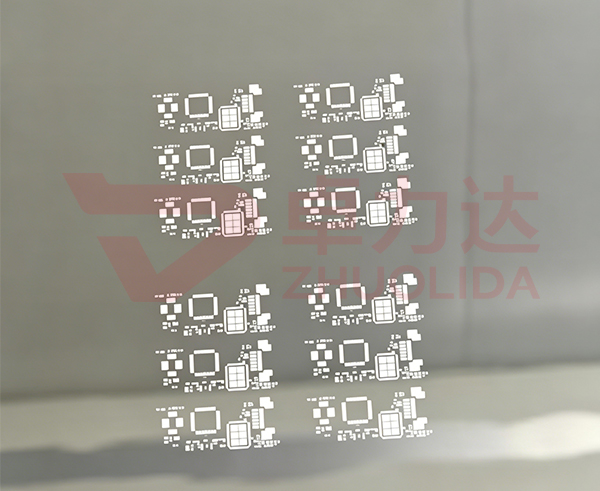
The semiconductor packaging and testing industry continues to evolve toward miniaturization, high density, and high reliability. Given the significant differences in pad layouts, test points, and packaging specifications across various chip types, generic wafer templates can no longer meet diverse production needs. As a result, custom mold development for semiconductor packaging and testing wafer templates based on brand-new design drawings has become the mainstream approach for adapting to new chip types, new production lines, and production line upgrades. This model offers a fully customized end-to-end process—from mold development and pattern design to finished product fabrication—allowing for flexible definition of microvia dimensions, array layouts, and board structures based on packaging and testing equipment parameters and chip process requirements. The manufacturing of semiconductor packaging and testing wafer templates integrates multiple core processes, including precision mold fabrication, photolithography, chemical etching, and electroforming. This approach accommodates both small-batch pilot production for new product development and large-scale commercial mass production, ensuring dimensional accuracy and machine compatibility. Leveraging precision design and end-to-end manufacturing capabilities, semiconductor packaging and testing wafer template mold manufacturers continuously optimize mold design and forming processes, consistently reducing mold deviations and shortening delivery cycles to provide new tooling support for the semiconductor packaging and testing industry chain.
The comprehensive production process consists of eight major stages: mold design, specialized master template fabrication, substrate selection and pretreatment, photolithographic pattern transfer, precision molding, cleanroom post-processing, comprehensive benchmarking inspection, and dust-free sealing. All processes are conducted within Class 100 temperature-controlled cleanrooms, with strict control over environmental dust, temperature, and humidity to prevent mold deviations, uneven aperture sizes, and board warping at the source. Custom mold design for semiconductor packaging and testing wafer templates incorporates different mold standards based on chip packaging grades and operating conditions, establishing differentiated mold precision metrics for automotive-grade, consumer-grade, and research-grade products. Depending on template thickness and microvia density, mold fabrication can flexibly employ either etching or electroforming processes, combined with dedicated molds to achieve integrated molding, ensuring uniform and consistent patterns across the entire board. Manufacturers of semiconductor packaging and testing wafer templates have established standardized mold review mechanisms, conducting multiple rounds of parameter verification before mold production begins, thereby effectively improving the first-pass success rate.
Mold design and the fabrication of dedicated master templates are the core preliminary steps in the customization of semiconductor packaging and testing wafer templates. Technical personnel integrate parameters such as wafer dimensions, chip die coordinates, probe specifications, equipment mounting benchmarks, and high/low-temperature operating environments to complete 3D structural design and mold drawing preparation. Simultaneously, they account for process compensation by considering etching side-etch coefficients and material deformation patterns, and plan auxiliary structures such as positioning holes, sealing grooves, and reinforcing ribs. After the drawings undergo multi-dimensional reviews covering process, structure, and precision, the production of specialized photolithography master templates and molding fixtures begins. Relying on high-precision equipment, complete pattern arrays are replicated to ensure sharp lines and precise hole positions on the master templates, laying the foundation for subsequent mass production. Custom mold manufacturing for semiconductor packaging and testing wafer templates supports both the development of new structures and the modification and upgrading of existing molds, facilitating the implementation of various new packaging and testing processes. The manufacturing of semiconductor packaging and testing wafer templates relies on custom master templates to achieve consistent replication of patterns, dimensions, and layouts, ensuring uniform product parameters across every batch. Manufacturers of these templates have accumulated vast amounts of mold-making data, developing mature design solutions for high-density micro-holes and irregular clearance structures, which significantly shortens the mold-making cycle.
Substrate selection and surface pretreatment are fundamental steps in ensuring the quality of custom-made semiconductor packaging and testing wafer templates. Based on the application scenario, we select ultra-thin stainless steel, nickel alloys, and other materials with low internal stress and high corrosion resistance. After warehousing, each sheet is individually inspected for thickness uniformity and surface flatness, and raw materials with scratches, oxidation, or thickness deviations are rejected. Pre-treatment involves a sequential process of alkaline ultrasonic degreasing, multi-stage purified water rinsing, plasma activation, and micro-etching leveling. This thoroughly removes oil residues and oxide layers from the surface, enhances the adhesion of the photoresist dry film, and prevents delamination and localized etching defects during the photolithography process. For ultra-thin substrates below 0.04 mm, a low-temperature stress-relief process is added to preemptively release the substrate’s inherent stress, thereby reducing the risk of warping and deformation after forming. For custom-made semiconductor packaging and testing wafer templates, the substrate model is finalized during the mold-making phase to ensure consistent material quality throughout long-term mass production. The cleaning processes for semiconductor packaging and testing wafer template manufacturing are categorized by cleanliness levels, with high-end packaging and testing templates adhering to multi-stage deep purification standards. Manufacturers of semiconductor packaging and testing wafer templates refine pre-treatment parameters for different materials, ensuring comprehensive product performance starting from the raw material stage.
Photolithographic pattern transfer and precision molding are critical processes in the custom mold manufacturing of semiconductor packaging and testing wafer masks. Dry film lamination and adhesive curing are performed in a cleanroom environment. High-precision alignment and exposure are achieved using custom master templates, followed by constant-temperature development to form a complete protective pattern, leaving the areas to be processed fully exposed. Conventional medium-to-low-density templates are formed using double-sided simultaneous chemical etching, while ultra-high-density micro-hole and ultra-thin high-precision templates employ an integrated electroforming process. Combined with custom tooling, this ensures precise control over micro-hole perpendicularity, aperture size, and spacing, limiting overall dimensional errors to the micrometer level. For complex templates with significant variations in density across zones and featuring irregular clearance grooves, a zone-by-zone exposure and segmented etching approach is employed to balance the formation rates across different areas. Custom mold manufacturing for semiconductor packaging and testing wafer templates relies on proprietary molds to achieve unique structural formations, meeting the positioning and guidance requirements of specialized chip packaging and testing. The entire manufacturing process for semiconductor packaging and testing wafer templates involves no mechanical compression, resulting in no processing stress on the substrate and excellent surface flatness. Manufacturers continuously optimize undercut etching solutions and electroforming parameters to enhance the forming precision of the final products.
Demolding, cleaning, and surface functionalization are critical steps in optimizing the performance of custom-made semiconductor packaging and testing wafer templates. After forming, specialized demolding agents are used to remove residual protective resin layers from the plate surface. This is followed by ultrasonic micro-pore cleaning, recirculating pure water washing, and vacuum drying to thoroughly remove chemical residues and metal debris from the pores, meeting the semiconductor industry’s stringent cleanliness requirements. Based on the specific requirements of packaging and testing operations, selective surface treatments such as electrolytic polishing, passivation for corrosion resistance, and anti-static coating are applied. These enhance the template’s wear resistance, anti-adhesion properties, and tolerance to high and low temperatures, thereby reducing accuracy degradation caused by repeated probe friction and extending the template’s service life. Custom mold manufacturing for semiconductor packaging and testing wafer templates can incorporate surface functional coatings tailored to customer requirements, ensuring compatibility with specialized testing environments. The manufacturing process for semiconductor packaging and testing wafer templates integrates forming and surface treatment into a single operation, ensuring consistent performance across the entire product. Manufacturers of these templates tailor surface treatment solutions to different application scenarios, enhancing the templates’ environmental adaptability.
Comprehensive precision inspection and cleanroom packaging constitute the final quality control steps before customized semiconductor packaging and testing wafer templates are shipped. Using equipment such as laser aperture profilometers, 3D profilometers, and flatness testers, we conduct item-by-item verification of aperture size, hole spacing, overall dimensions, and positioning accuracy against the mold drawings. Concurrently, we perform on-machine simulation tests to replicate actual packaging and testing pressures and temperatures, validating the template’s alignment and positioning effectiveness. Products that pass inspection undergo anti-static vacuum packaging in a cleanroom environment to isolate them from dust and moisture during storage and transportation, thereby preventing oxidation and deformation of the material. The custom mold manufacturing process for semiconductor packaging and testing wafer templates implements a three-party verification system involving drawings, master templates, and finished products. A comprehensive re-inspection of the first-article product is conducted before initiating mass production. Manufacturers of semiconductor packaging and testing wafer templates establish mold-making archives, retaining drawings, master templates, and inspection data to facilitate future reorders and mold maintenance.
Custom mold design and manufacturing for semiconductor packaging and testing wafer templates are widely used in the packaging and testing processes of automotive chips, high-capacity memory chips, micro-sensor chips, and high-end logic chips, serving as a critical supporting component for the mass production of new chip types. Leveraging flexible process combinations, semiconductor packaging and testing wafer template mold manufacturing continues to overcome the challenges of forming complex structural templates. Manufacturers of semiconductor packaging and testing wafer templates closely follow trends in semiconductor technology and continuously upgrade their mold design and processing capabilities.
In automotive power chip packaging and testing applications, automotive-grade chips require testing across a wide temperature range with stringent stability requirements. Custom mold design for semiconductor packaging and testing wafer templates optimizes reinforcement structures and temperature resistance from the mold design stage. The manufacturing process strictly controls micron-level tolerances to ensure dimensional stability under both high and low temperatures. Manufacturers of semiconductor packaging and testing wafer templates implement automotive-grade quality control throughout the entire process to ensure long-term stability in packaging and testing.
In applications for high-capacity memory chip packaging and testing, memory wafer templates feature large surface areas and densely packed microvia holes. Custom mold design for these templates optimizes the overall pattern layout and stress distribution. The manufacturing process employs a zoned molding technique to ensure uniform hole diameters across the entire template. Manufacturers of semiconductor packaging and testing wafer templates refine molding parameters to resolve warpage issues in large-format templates.
In applications for micro-sensor chip packaging and testing, sensor chip templates feature irregularly shaped clearance structures with complex designs. Custom mold design for semiconductor packaging and testing wafer templates relies on proprietary master templates to precisely replicate irregular slots and micro-hole arrays. The manufacturing process involves meticulous control over molding details to avoid obstructing functional areas of the chips. Manufacturers of these templates have refined precision mold standards to meet the exacting requirements of microchip packaging and testing.
Overall, custom mold manufacturing for semiconductor packaging and testing wafer templates serves as a critical supporting model for new chip R&D and production line upgrades, effectively meeting diverse packaging and testing production needs. The manufacturing process relies on mature mold development and precision forming techniques to ensure the comprehensive quality of the templates. Manufacturers of semiconductor packaging and testing wafer templates continue to deepen their expertise in mold design and processing technologies, leveraging their professional capabilities to support the high-quality development of China’s domestic semiconductor packaging and testing industry.
Contact:赖先生
Phone:+86 18938693450
Tel:0755-2708-8292
Email:yw9@zldsmt.com
Add:深圳市宝安区福永镇新和村福园一路华发工业园A3栋
 Zhuolida