Welcome: Shenzhen Zhuolida Electronics Co.TD
Language:
 ∷
∷

∷
∷
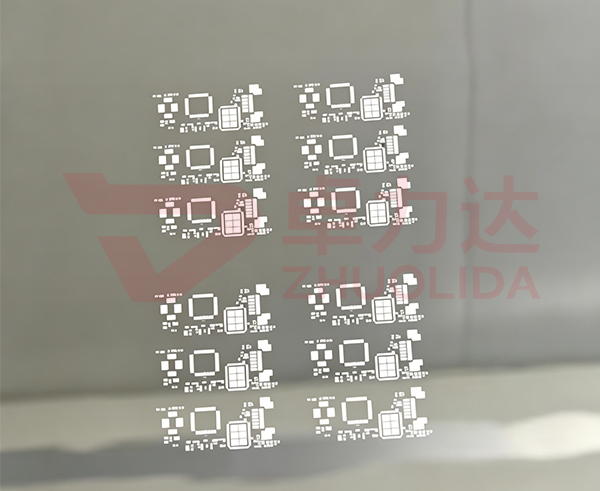
With the widespread adoption of the 5G communications industry, chips such as baseband, RF, and millimeter-wave devices are increasingly moving toward high-density pin counts, narrow-pitch pads, and high-frequency testing conditions. Traditional wafer templates struggle to meet the requirements for signal stability, micro-hole precision, and long-term temperature resistance. As a core fixture in the chip CP testing and final packaging stages, 5G chip packaging and testing wafer templates play a critical role in probe guidance, die protection, and electromagnetic isolation. Their precision and stability directly impact high-frequency signal detection results and chip packaging yield. The manufacturing of 5G chip packaging and testing wafer templates integrates multiple processes, including precision photolithography, chemical etching, electroforming, and high-frequency adaptation modifications, to create customized production solutions tailored to the high-frequency, high-density, and multi-condition characteristics of 5G chips. Manufacturers of 5G chip packaging and testing wafer templates continuously optimize process parameters and material systems to overcome technical challenges such as narrow aspect ratios, low signal loss, and thermal deformation at high and low temperatures, providing reliable support for the entire 5G chip packaging and testing process.
5G chip packaging and testing wafer templates follow a rigorous closed-loop production process, which is divided into eight major stages: simulation-based design, selection of specialty substrates, deep surface pretreatment, high-precision pattern transfer, precision molding, high-frequency adaptation post-processing, comprehensive multi-dimensional inspection, and Class 100 cleanroom packaging. The entire process is conducted in temperature-controlled, dust-free cleanrooms with strict control over dust, temperature, and humidity to prevent issues such as microvia misalignment, board warping, and signal interference. The processing of wafer templates for 5G chip packaging and testing distinguishes between forming processes and surface treatment solutions based on different chip types, such as 5G RF, baseband, and automotive communication chips, while accommodating the production requirements for both full-size wafer templates and localized irregular-shaped templates. Manufacturers of 5G chip packaging and testing wafer templates establish multi-tiered production standards based on consumer-grade and automotive-grade 5G chips, dynamically adjusting etching rates, electroforming currents, and coating parameters to ensure consistent template performance across different application scenarios.
Simulation-based design is the critical first step in the mass production of 5G chip packaging and testing wafer templates. By integrating 5G wafer dimensions, probe specifications, pin pitch, high-frequency test bands, and high/low-temperature operating conditions, simulation software is used to model probe movement trajectories, signal transmission paths, and stress states of the template. This enables optimization of microvia aperture sizes, wall taper angles, shielding structures, and edge reinforcement layouts. For ultra-high-density pin arrays, process compensation values are calculated in advance to mitigate dimensional deviations caused by side etching, while additional electromagnetic shielding structures are incorporated to reduce signal crosstalk during testing. The final design is finalized after multiple rounds of electrical and structural verification. The manufacturing of 5G chip packaging test wafer templates is tailored from the design stage to meet the high-frequency testing requirements of 5G chips, differing from the design logic of standard chip templates. Manufacturers of 5G chip packaging test wafer templates have accumulated extensive high-frequency template design data, shortening the time-to-market for new product solutions.
The selection of specialized substrates and board surface pretreatment form the foundation for ensuring the comprehensive performance of 5G chip packaging and testing wafer templates. Specialized materials such as nickel-based alloys and ultra-thin stainless steel—which feature low dielectric constants, low stress, and corrosion resistance—are prioritized. Upon arrival, each sheet is individually inspected for thickness uniformity, surface flatness, and material purity, with raw materials exhibiting internal stress or excessively thick oxide layers being rejected. The pretreatment process sequentially includes alkaline ultrasonic degreasing, multi-stage purified water rinsing, plasma activation, and micro-etching leveling to thoroughly remove surface impurities and enhance the adhesion of photoresist and functional coatings. High-frequency test templates demand extremely high cleanliness standards, as even minute impurities can cause signal distortion. For ultra-thin substrates, an additional low-temperature stress-relief process is incorporated. The fabrication of 5G chip packaging and testing wafer templates strictly matches the electromagnetic parameters of the substrate to ensure stable high-frequency signal transmission. Manufacturers of 5G chip packaging and testing wafer templates have refined their multi-stage cleaning processes, with automotive-grade 5G chip templates adhering to the highest cleanliness control standards.
High-precision pattern transfer is the core process determining the micro-hole accuracy of 5G chip packaging and testing wafer templates. Dry film lamination and adhesive curing are performed in a Class 1,000 cleanroom environment. Micron-level alignment and exposure are achieved using laser direct writing equipment, and after constant-temperature development, a complete array of microvias, registration holes, and shielding grooves is formed. Due to the dense pin layout of 5G chip templates and extremely small hole spacing in certain areas, a zone-based exposure mode is adopted to balance development results across different regions and prevent pattern defects or blurred edges. The fabrication of 5G chip packaging and testing wafer templates relies on high-precision patterning technology to achieve the complete replication of ultra-narrow-pitch microvias. Manufacturers of these templates continuously upgrade their exposure equipment to control alignment errors to the micrometer level, ensuring consistency across the entire template array.
Precision molding is a critical step in the fabrication of wafer templates for 5G chip packaging and testing. Conventional high-density templates utilize double-sided simultaneous chemical etching, with precise control of spray pressure and chemical concentration to suppress lateral side etching and ensure vertical, smooth hole walls. Ultra-high-precision high-frequency templates employ an integrated electroforming process, which eliminates mechanical stress, resulting in a flat, distortion-free surface capable of withstanding long-term, high-frequency repetitive testing. Both processes effectively prevent issues such as burrs and protrusions, thereby protecting 5G chip dies and test probes from scratches. The manufacturing of 5G chip packaging and testing wafer templates flexibly switches between forming processes based on precision and frequency band requirements. Manufacturers of 5G chip packaging and testing wafer templates continuously refine low-side-etch solutions and electroforming parameters to consistently improve the quality of micro-hole formation.
High-frequency post-processing is key to extending the service life and ensuring testing stability of 5G chip packaging and testing wafer templates. After demolding, micro-hole cleaning, and vacuum drying, the formed workpieces undergo anti-static, electromagnetic shielding, and passivation/corrosion-resistant treatments tailored to the test frequency band. This creates a uniform functional coating on the surface, reducing contact resistance and signal loss while enhancing the template’s resistance to high and low temperatures and friction, making it suitable for long-term continuous testing of 5G chips. The processing of 5G chip packaging and testing wafer templates involves customizing specific coating solutions for different frequency bands. Manufacturers of these templates integrate multiple surface treatment processes to achieve integrated operations for both forming and functional enhancement.
Comprehensive testing and clean packaging constitute the final quality control stage before 5G chip packaging and testing wafer templates are shipped. In addition to inspecting standard dimensions such as aperture size, pitch, and flatness, additional tests are conducted, including high-frequency signal testing, high-low temperature cycling tests, and simulated on-machine durability tests, to fully verify the templates’ stability under 5G testing conditions. Qualified products undergo anti-static vacuum packaging in a cleanroom environment. The manufacturing of 5G chip packaging and testing wafer templates adheres to a “one product, one file” full-inspection system. Manufacturers of these templates have established a comprehensive quality traceability system that retains all inspection data.
Currently, 5G chip packaging and testing wafer templates are widely used in consumer communications, automotive RF, and industrial wireless fields. The manufacturing of these templates continuously evolves in tandem with advancements in 5G chip processes, and manufacturers are constantly overcoming technical bottlenecks in high-frequency precision machining.
In consumer 5G RF chip applications, these chips feature dense pin arrangements and operate at high test frequencies. 5G chip packaging and testing wafer templates optimize microvia layouts and shielding structures to minimize signal interference. Manufacturing processes strictly control microvia precision to ensure accurate probe alignment. Manufacturers also optimize surface coatings to reduce high-frequency signal loss.
In automotive 5G communication chip applications, operating conditions involve significant temperature fluctuations and frequent vibrations. 5G chip packaging and testing wafer templates feature reinforced board structures and enhanced temperature resistance. The manufacturing process employs low-stress techniques to prevent thermal deformation. Manufacturers adhere to automotive-grade standards to ensure long-term operational stability.
In industrial 5G baseband chip applications, testing cycles are lengthy, and requirements for continuous operation are high. 5G chip packaging and testing wafer templates enhance wear resistance and fatigue resistance. Manufacturing processes for these templates refine forming parameters to extend their service life. Manufacturers optimize overall processes to meet the demands of industrial mass production testing.
Overall, 5G chip packaging and testing wafer templates are indispensable precision fixtures for 5G chip packaging and testing. Their manufacturing integrates multiple processes to meet high-frequency precision requirements, and manufacturers continue to deepen their technical expertise to fully support the high-quality development of China’s 5G communications industry.
Contact:赖先生
Phone:+86 18938693450
Tel:0755-2708-8292
Email:yw9@zldsmt.com
Add:深圳市宝安区福永镇新和村福园一路华发工业园A3栋
 Zhuolida