Welcome: Shenzhen Zhuolida Electronics Co.TD
Language:
 ∷

∷
∷
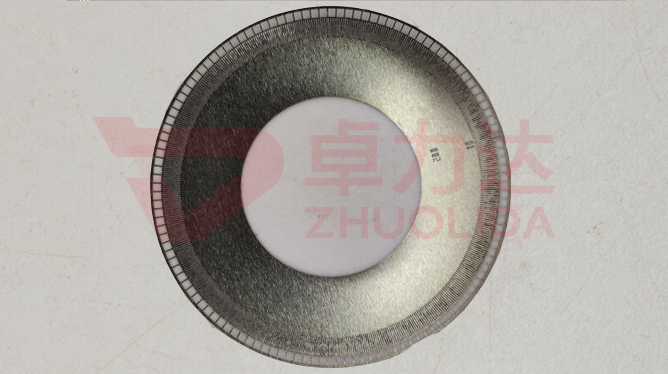
Filtration rating of electroformed screens settles an old problem: nominal mesh count and the particle size a screen actually stops are separated by a conversion nobody writes down. Mesh count belongs to woven cloth, where it counts strands per inch and pore size equals pitch minus strand diameter. An electroformed screen grows its pores in a nickel sheet; there are no strands, only bridges, so the same 400 mesh can differ by 8 μm in pore size between woven and electroformed product. Rating is the work of reconciling two languages: a nominal pore derived from mesh count, and a retention size measured with reference media. Only the second one belongs in a filtration spec.
Without a common rating convention, three kinds of trouble appear. A customer orders 500 mesh and receives screens averaging 28 μm, which look correct until 45 μm glass beads pass straight through at 62% retention and the filtrate fails on arrival. Two suppliers both quote 400 mesh, one at 38 μm and one at 46 μm, and the same skid runs at half the flow rate, leaving purchasing convinced they bought the same item twice. Others treat a bubble point as absolute rating: the reading shows a 60 μm maximum pore and the lot is rejected, although the mean pore is 30 μm, so the judgement went the wrong way. Inspectors then hold a pore report and a retention report that disagree, and the argument is no longer about the product but about the convention.
Parameter Window
• Nominal mesh = 25.4/(pore + bridge) in mm, and quotes carry both nominal pore and measured mean pore.
• Pore tolerance ±3 μm, minimum pore 30 μm, bridge spacing ≥50 μm and pitch ≥120 μm.
• Retention ≥98% before a grade is called absolute, tested with glass beads graded 10–80 μm or monodisperse latex spheres.
• Bubble-point maximum pore ≤1.3× nominal pore, with test liquid surface tension 16–30 mN/m.
• Screen thickness 15–200 μm; below a thickness-to-pore ratio of 0.8 retention drops a grade and the rating note must say so.
• Challenge differential pressure 0.05–0.2 MPa, 100 mL per pass, with the filtrate re-measured for particle size.
Manufacturing Process (8 Steps)
1. Substrate preparation — stainless substrate degreased and acid dipped, flatness held within 1 μm so pores do not skew.
2. Coating and exposure — LDI writes the pore array at 8 μm/8 μm, double-sided alignment ±5 μm, pores biased 0.3 μm larger.
3. Development — time set per pore density, resist cleared from every pore, no skirt left on the sidewall.
4. Electroforming — current density staged across 1–4 A/dm², one step lower at pore rims, nickel grown to 15–200 μm.
5. Stripping — the sheet lifts from a corner at a shallow angle with temporary support over dense arrays, so pores are not stretched.
6. Cleaning and anneal — ultrasonic DI rinse, then 2 h at 120–150 °C so the sheet flattens and pores stop springing.
7. Pore re-measurement — an image measurer maps pore size to ±3 μm and spacing region by region, producing a distribution and a mean.
8. Rating — bubble point gives the maximum pore, bead challenge gives retention, and the two together fix the absolute grade.
Core Advantages
1. Converting mesh to microns on one table lets a customer order in either unit without landing on a different product.
2. Retention comes from media testing rather than pore arithmetic, so whether a 45 μm bead passes has data behind it.
3. Bubble point and bead challenge run side by side, reporting maximum and mean pore separately instead of collapsing both into one number.
4. A ±3 μm pore tolerance ships with a distribution map, so the weakest region of a lot is visible, not averaged away.
5. The rating report travels with the goods, and a supplier change can be checked against the old report without repeating validation.
6. Thickness-to-pore ratio is recorded, so the weaker retention of thin screens is stated up front rather than discovered later.
Typical Applications
1. Abrasive and polishing slurry classification, where nominal mesh must match the real cut size or the grit bands blur.
2. Coating and ink filtration, holding back agglomerates above 45 μm that cost more in rework than the screen.
3. Battery slurry screening, where metal foreign matter is judged by retention size and the report must name the test medium.
4. Pre-filters ahead of pharmaceutical and biological filtration, with retention data supplied lot by lot.
5. Fuel and hydraulic filter discs, where the bubble point maps to maximum pore and drives the contamination class.
6. Water treatment micro-screens, where one grade of gap between nominal and actual retention shows up as turbidity.
Design and Selection Notes
1. Ask whether the order is in mesh or in microns before quoting; mixing the two starts most disputes.
2. Finer mesh is not automatically better. Below 20 μm pores the flux falls away and cartridge life shortens instead.
3. Judge a grade by the maximum pore, not the mean; the largest hole is the one that leaks particles.
4. If retention hovers at 90–95%, go back to the tail of the pore distribution before changing the nominal figure.
5. Name the test medium in the contract; glass bead and latex sphere results are not interchangeable.
6. Open area is an areal figure and does not track retention size, so read the two separately at selection.
7. On screens thinner than 30 μm, drop the challenge pressure one step or the sheet deforms before the rating is done.
Rating an electroformed screen is translation work: turning pore size, bridge width and thickness from the shop floor into microns and retention a customer can accept. Whether the translation holds up comes down to three things, a pore distribution with its tail shown, a challenge test whose medium and pass criterion are written out, and a bubble point that agrees with the nominal pore. With all three, 400 mesh is the band around 38 μm, 500 mesh the band around 28 μm, and acceptance does not turn into an argument. For orders where the mesh-to-micron conversion is uncertain, sending 200 mL of the actual slurry through a trial screen settles more than any discussion on paper.
Contact:赖先生
Phone:+86 18938693450
Tel:0755-2708-8292
Email:yw9@zldsmt.com
Add:深圳市宝安区福永镇新和村福园一路华发工业园A3栋
 Zhuolida