Welcome: Shenzhen Zhuolida Electronics Co.TD
Language:
 ∷

∷
∷
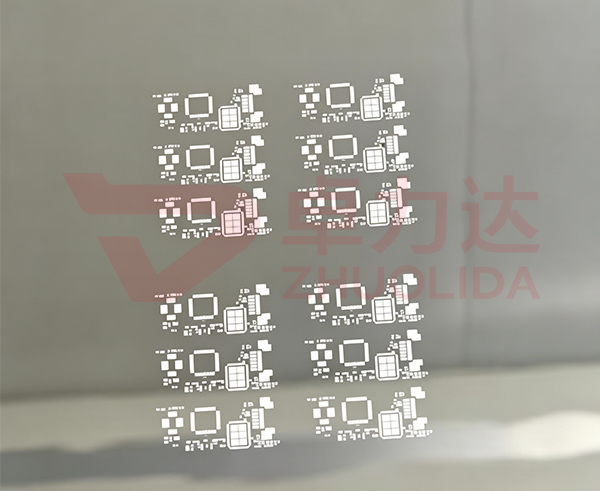
Zhongshan electroformed code disc processing grows the division lines of an encoder into a nickel disc, where line width, line spacing, line edge and division position must all match the drawing. A code disc is neither printed nor punched; the line is set by the resist image written with LDI, and development undercut, current nodules or lift-off load all rewrite the edge. On receiving a finished disc, the inspector takes several lines along the division circle on a vision gauge to read pitch and line width, switches to a flash gauge for edge burrs, and judges rework or scrap against the drawing. Once the 50 μm±0.5 μm code track drifts, the encoder read-out turns into wrong code.
Three routes make division go off on the line. Development undercut eats down the resist sidewall, the line edge goes rough and width grows out of the 50 μm±0.5 μm band, and fine ribs fail first. At a current density of 1–4 A/dm² the field lines crowd at the line corners, nickel grows faster along the edge, a ring of nodules bulges and a flash gauge picks up burrs. Under uneven lift-off load the fine ribs are pulled out of line, division pitch departs from the drawing, and when double-sided alignment ±5 μm is missed the front and back lines no longer line up. Out-of-tolerance discs are tagged on the vision gauge at once: the light ones go back through development, the heavy ones are scrapped. What Zhongshan electroformed code disc processing has to watch is the edge account between resist image and lift-off.
Parameter Window
• Code track 50 μm±0.5 μm as the line-width acceptance band, pitch re-measured by quadrant on a vision gauge; division accuracy follows the drawing and actual measurement, with no universal grade promised.
• Aperture rib line width 20 μm, fine ribs vulnerable to undercut thinning, with development time shortened to the rib-width band on its own.
• LDI resolution 8 μm/8 μm and double-sided alignment ±5 μm; discs whose front and back lines miss alignment never reach the bath.
• Maximum substrate 610×660 mm for whole-panel multi-piece layout, line position accuracy ±7 μm checked piece by piece.
• Current density staged at 1–4 A/dm², the edge dropped one band to suppress nodules, nickel alloy hardness 450–550 Hv.
• Edge roughness ≤0.01 μm, with low-temperature anneal after lift-off releasing stress so fine ribs do not spring back and skew the edge.
Manufacturing Process (8 Steps)
1. Substrate prep — degrease, clean and dry the stainless substrate, and let it rest to temperature before dry-film lamination.
2. Lamination and exposure — write the code track and lines by LDI after lamination at 8 μm/8 μm resolution, line width placed from the compensation value.
3. Development — developer temperature and time held to the line-width band, fine-rib sidewalls flushed clean of residue so undercut narrows.
4. Resist check — a vision gauge samples line width and edge slope, rough or collapsed edges stopped on the spot.
5. Electroforming — current density staged at 1–4 A/dm², the edge dropped a band to curb edge effects, grown to target thickness.
6. Lift-off — raise the disc in one sheet from a low-stress corner at a shallow angle, fine-rib zones backed first.
7. Low-temperature anneal — relieve internal stress in the nickel so the line edge no longer needs the substrate to hold it straight.
8. Edge recheck — a vision gauge reads line width and division, a flash gauge scans edge burrs, then the inspection report is issued.
Core Advantages
1. Clean edges — Zhongshan electroformed code disc processing locks undercut and current edge into one window, so division lines leave no nodules.
2. Recheckable division — division accuracy follows the drawing and measurement, pitch read line by line on a vision gauge, report traceable.
3. Held line width — code track 50 μm±0.5 μm reads the same after lift-off and anneal, without the substrate propping it up.
4. Steady alignment — double-sided alignment ±5 μm written into the inspection card, front and back lines kept off each other.
5. Consistent lots — a dozen discs from one bath share a compensation card, lot changes need no re-tune, fine-rib spread stays small.
6. Clear delivery terms — for Zhongshan and nearby customers, drawing requirements and the inspection report use one set of terms.
Typical Applications
1. Incremental encoder discs, where division pitch directly sets read-out resolution.
2. Motor encoder discs, a common drawing part for motor assembly customers in and around Zhongshan.
3. Optical code discs and aperture blades, where 20 μm aperture ribs are most vulnerable to undercut thinning.
4. Robot joint encoder discs, where edge burrs rub against the read head.
5. Servo and numerical-control discs, with cumulative division error re-measured line by line to the drawing.
6. Export discs needing RoHS and traceable reports, the inspection card shipping with the goods.
Design and Selection Notes
1. Fix division accuracy to the drawing on Zhongshan electroformed code disc processing first; do not quote a universal grade, state the division-circle diameter and pitch basis.
2. Set the line-width compensation value by code track band; do not reuse wide-line figures for 20 μm fine ribs.
3. Put development time and bath temperature into the process card; shorten fine ribs separately since their undercut allowance is thin to begin with.
4. Step edge current density down one band, do not sit at the 4 A/dm² ceiling for long runs growing nodules.
5. Check double-sided alignment ±5 μm before exposure, do not wait until lift-off to find the faces out of line.
6. Scan edge burrs with a flash gauge, since a vision gauge watching only line width easily misses edge defects.
7. Division accuracy follows the drawing and measurement with no universal grade promised; if a line pitch drifts beyond the card range, return to the development and exposure stages for a recheck.
Taken apart, Zhongshan electroformed code disc processing is not about the place name but about the account from resist image to finished disc on division and line edge. The resist sets the line, development sets edge slope, current sets how the edge grows, and lift-off sets whether fine ribs are dragged out of line; loosen any one and code track 50 μm±0.5 μm and double-sided alignment ±5 μm are just figures on paper. What separates capable lines is whether the pitch still lines up across a dozen discs from one bath and after a fresh lot of dry film, not whether a few handsome lines can be picked from a single piece. Finer is not always better: fine ribs fear both undercut and lift-off damage, and ask more of development and lift-off. For encoder orders from Zhongshan and nearby customers, fix the compensation value, development time, current bands and lift angle into the process card at sampling stage and run to that card in volume.
Contact:赖先生
Phone:+86 18938693450
Tel:0755-2708-8292
Email:yw9@zldsmt.com
Add:深圳市宝安区福永镇新和村福园一路华发工业园A3栋
 Zhuolida