Welcome: Shenzhen Zhuolida Electronics Co.TD
Language:
 ∷
∷

∷
∷
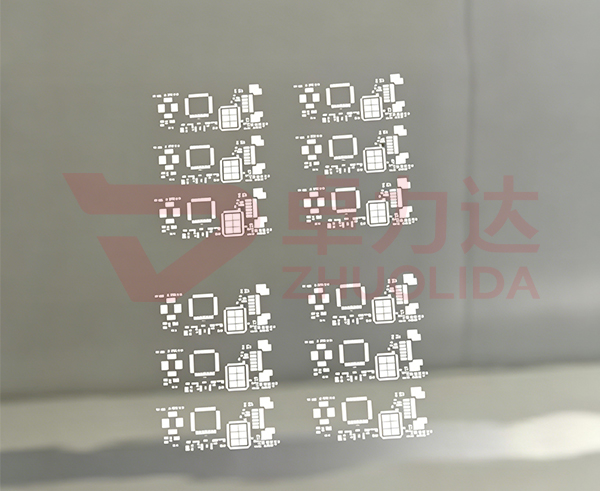
In semiconductor wafer optoelectronic testing, chip exposure and packaging, and photoresistive die electrical testing processes, stray light and ambient scattered light can easily interfere with the electrical parameters of photoresistive chips, image detection accuracy, and exposure patterning results. This leads to mass production defects such as incorrect wafer test results, damage to chip photoresistive structures, and packaging pattern misalignment. Semiconductor packaging and testing wafer shading templates feature opaque metal substrates and precision-cut optical path structures. They block ambient stray light, define the effective light-receiving area of the wafer, and shield non-test photosensitive die. These templates serve as core precision fixtures for wafer optoelectronic testing, exposure and packaging, and visual sorting, accommodating multiple operating conditions such as zone-specific shading for entire wafers, localized optical path openings, and comprehensive light-shielding protection. The manufacturing of semiconductor packaging and testing wafer shading templates relies on an integrated process combining cleanroom lithography, low-stress chemical etching, optical blackening modification, and micron-level alignment calibration. This approach accommodates both small-batch custom samples and high-volume mass production on packaging and testing lines, meeting the production needs for shading templates across all wafer sizes from 6 inches to 12 inches. As a manufacturer of semiconductor packaging and testing wafer shading templates, we specialize in supporting optical tooling processes for the packaging and testing industry. We have overcome key manufacturing challenges such as light transmission defects in ultra-thin templates, light fringing at perforated edges, surface reflections, and alignment deviations on large panels, ensuring compliance with semiconductor precision optoelectronic packaging and testing production standards.
The entire production process is conducted in a closed-loop environment within a Class 100, temperature-controlled, light-shielded, and dust-free semiconductor cleanroom. It comprises optical condition simulation design, selection of specialized light-shielding substrates, ultra-clean pre-treatment of the substrate surface, optical-grade photolithographic pattern transfer, controlled etching of light-shielding cutouts, light- and dust-free film removal and purification, optical anti-glare modification and calibration, comprehensive optical alignment quality inspection, and light-shielding vacuum encapsulation. We strictly control workshop parameters such as illumination, dust levels, and chemical solution concentrations to eliminate the four major process defects: template light transmission, edge burrs, panel surface reflections, and cutout misalignment. Semiconductor packaging and testing wafer masking templates are categorized into three main types: full-area masking templates, partially windowed masking templates, and die-segmented masking templates, catering to the differentiated packaging and testing requirements of photosensitive chips, image sensor chips, and optoelectronic wafers. The manufacturing of semiconductor packaging and testing wafer shading masks follows three tiers of process standards—conventional commercial packaging and testing, automotive-grade optoelectronic packaging and testing, and high-precision optical packaging and testing—to meet varying requirements for shading precision and optical durability. Manufacturers of these masks establish dedicated process databases for optical templates, optimizing blackening coatings and etching parameters to ensure high consistency in the optical and mechanical performance of each batch.
Optical condition matching and optical path simulation design are the primary preliminary steps before mass production of semiconductor packaging and testing wafer shading templates. Technical personnel conduct optical simulation modeling based on wafer dimensions, photosensitive die arrays, optical path aperture ranges, test light source wavelength bands, and equipment positioning benchmarks. They calculate etching compensation values and surface stress distributions to plan the layout of shading solid areas, transparent aperture zones, equipment alignment holes, and edge-limiting structures. This precisely blocks stray light from non-test areas of the wafer while preventing the mask from compressing the bare wafer or coating structure during lamination. For high-density optoelectronic wafer arrays, narrow-slot shading partition structures are optimized to eliminate optical crosstalk between zones. Production plans are finalized only after drawings undergo triple verification for optical shading, dimensional accuracy, and lamination compatibility. Optical path simulation and debugging for semiconductor packaging and testing wafer shading masks are completed prior to fabrication, improving the mask’s shading pass rate during machine operation and ensuring optimal production line compatibility. Manufacturers of semiconductor packaging and testing wafer shading masks align with mainstream optoelectronic packaging and testing processes as well as wafer exposure processes, enabling rapid template iteration and new product launch.
The careful selection of optical-grade substrates and surface pretreatment lay the foundation for the optical quality of light-shielding templates used in semiconductor packaging and testing. We use virgin, opaque, low-reflectivity, low-internal-stress, temperature- and corrosion-resistant specialty alloy sheets in production. Upon arrival, we screen the substrates for density, surface reflectivity, and thickness uniformity, rejecting materials with internal micro-pores, surface bright spots, or excessive stress. This eliminates issues such as natural light penetration and surface diffuse reflection at the substrate source. Pre-treatment involves a sequential process of light-shielded ultrasonic degreasing, multi-stage closed-loop rinsing with ultrapure water, plasma surface passivation, and micro-etching for surface leveling. This thoroughly removes oil residues, oxide layers, and fine dust from the surface, enhancing the adhesion of photoresist and anti-reflective coatings while preventing delamination in open areas and deformation during etching. Ultra-thin light-shielding templates undergo an additional low-temperature stress-relief process to eliminate the risk of optical path misalignment caused by panel deformation. The manufacturing of light-shielding templates for semiconductor packaging and testing wafers adheres to ultra-high-cleanliness and low-light production control standards specific to optical components, preventing strong light from interfering with the optical performance of semi-finished products. Manufacturers of these templates optimize pre-treatment processes by tier, with templates for high-end optoelectronic wafers undergoing a dual-pass passivation and cleaning process.
Micron-level optical lithography pattern replication ensures core precision in the aperture and shading areas of semiconductor packaging and testing wafer masks. Matte photosensitive dry films are uniformly laminated and cured in sealed, low-light, dust-free workstations. Equipped with optical alignment laser direct-write equipment, the process achieves precise exposure of transparent apertures, solid masking areas, and reference positioning holes through a single, precise exposure. For large-area interlaced masking structures, a zone-specific light energy balancing exposure process is employed to harmonize the development rates between dense windowing zones and large-area masking zones, thereby eliminating defects such as jagged window edges, pattern misalignment, and localized film defects. After constant-temperature slow development, the protective patterns are cured. The light-blocking areas retain dual protection from both the substrate and the adhesive layer, while the light-transmitting window areas expose the metal substrate, perfectly replicating the wafer’s optical path design blueprint. The fabrication of semiconductor packaging and testing wafer masking templates enables the simultaneous formation of tens of thousands of micro-windows across the entire wafer, ensuring consistent optical path dimensions across the entire surface. Manufacturers of semiconductor packaging and testing wafer masking templates have upgraded their optical vision alignment systems, strictly controlling window alignment errors within the tolerances of optical packaging and testing.
Controlled, uniform chemical etching on both sides is the core forming process in the manufacturing of semiconductor packaging and testing wafer masking templates. Coated workpieces are loaded into a sealed, light-shielded, corrosion-resistant etching chamber. A specialized, eco-friendly etching solution with low side-etch rates—formulated specifically for optical templates—is used. Solution parameters and dual-sided spray rates are controlled at a constant temperature to uniformly spray-etch and form transparent apertures. Lateral etching is strictly controlled to ensure the inner walls of the apertures are vertical, smooth, burr-free, and free of flared edges, thereby preventing edge diffraction and light scattering issues. The entire process involves no mechanical cutting or external pressure, eliminating secondary processing stresses in the mask. The mask surface exhibits excellent flatness, meeting wafer bonding and assembly requirements, and will not scratch the wafer’s photosensitive coating or the surface of the die. The fabrication of semiconductor packaging and testing wafer shading masks integrates contour cutting, optical window etching, and positioning hole formation into a single process, streamlining downstream processing steps. Manufacturers of semiconductor packaging and testing wafer mask templates have optimized the chemical solution system to balance etching precision, optical performance, and facility environmental production requirements.
Dust-free stripping, cleaning, and anti-glare blackening modifications optimize the optical shading performance of semiconductor packaging and testing wafer shading templates. After etching, a non-reflective neutral stripping agent is used to remove residual photoresist from the plate surface. Through targeted ultrasonic cleaning of micro-apertures, multi-stage ultrapure water rinsing under light-shielded conditions, and vacuum low-temperature drying, residual etching residues and metal debris within the apertures are thoroughly removed. Subsequent processes include matte blackening and passivation, anti-static treatment, and anti-photoaging composite processing to eliminate metal reflections on the surface, enhance light-blocking efficiency, improve electrostatic protection, and increase durability against light exposure, thereby preventing secondary interference from template reflections during wafer optoelectronic testing. The processing of semiconductor packaging and testing wafer light-blocking templates uniformly controls the thickness of the blackening film layer to ensure comprehensive light-blocking efficiency and eliminate localized light leakage. Manufacturers of semiconductor packaging and testing wafer shading templates integrate etching, cleaning, and optical modification into a single, streamlined process, thereby shortening the delivery cycle for custom orders.
Optical alignment 100% inspection and light-shielding vacuum packaging ensure that quality control standards for semiconductor packaging and testing wafer shading masks are strictly maintained. We utilize optical transmittance testers, 3D profilometers, and flatness testers to inspect the mask’s shading efficiency, window precision, and surface flatness. By replicating actual packaging and testing light source conditions, we simulate shading tests on wafers during machine operation to verify the effectiveness of stray light blocking and optical path alignment. Qualified finished products are packaged in light-shielding, anti-static vacuum packaging to isolate them from light, moisture, and dust during storage and transportation, thereby preventing coating oxidation and changes in surface reflectivity. The manufacturing of semiconductor packaging and testing wafer shading templates establishes a dedicated “one-item-one-file” quality inspection system for optical components, with item-by-item acceptance based on optical path drawings. Manufacturers retain full-process technical parameters to ensure end-to-end traceability of the optical performance of batch templates.
Semiconductor packaging and testing wafer shading templates are widely used in three major packaging and testing fields: image sensor wafers, photodiode wafers, and automotive photosensitive chips. Manufacturers of these templates continuously optimize their processes to meet the trend toward high-precision packaging and testing of optoelectronic chips. By tackling the challenges of optical processing, these manufacturers help the semiconductor optoelectronic packaging and testing industry improve quality and efficiency.
Image Sensor Wafer Packaging and Testing Case Study: CMOS image sensor wafers feature densely packed photosensitive pixels, making them highly susceptible to ambient stray light that can easily affect imaging test data. Semiconductor packaging and testing wafer shading templates provide high shading efficiency across the entire surface, effectively blocking peripheral scattered stray light. Manufacturers implement precise quality control during processing to ensure the flatness of the aperture edges, thereby eliminating diffraction interference. Manufacturers of light-shielding templates for semiconductor packaging and testing wafers optimize matte coatings to eliminate the risk of surface reflections.
Photodiode Wafer Packaging and Testing Case Study: Photodiode chips have extremely high light sensitivity, requiring stringent specifications for zone-specific light shielding and time-division testing fixtures. Light-shielding templates for semiconductor packaging and testing wafers feature independent light-shielding apertures for each zone, supporting time-division electrical testing. Semiconductor packaging and testing wafer mask manufacturers fine-tune the spacing of etched apertures to achieve independent optical path isolation for each die. Manufacturers optimize the zone-specific etching process to support mass production testing of photodiode wafers.
Automotive photosensitive chip wafer packaging and testing case: Automotive-grade photosensitive chips have stringent requirements for weather resistance and optical stability; masks must be temperature-resistant and resistant to aging. Semiconductor packaging and testing wafer shading masks feature a composite anti-aging blackening coating, ensuring consistent shading performance in both high and low-temperature environments. The manufacturing process for these masks includes enhanced substrate stress-relief techniques, ensuring no deformation or light leakage during long-term machine operation. Manufacturers adhere to automotive-grade optical quality control standards, meeting the qualification requirements for automotive chip packaging and testing.
Overall, semiconductor packaging and testing wafer light-shielding templates are core optical fixtures for optoelectronic wafer packaging and testing. Their manufacturing relies on optical-grade etching and blackening processes to address key challenges in light-shielding fabrication. Manufacturers specializing in these templates have deep expertise in semiconductor optical support processing, comprehensively empowering the high-quality development of China’s optoelectronic semiconductor packaging and testing industry.
Contact:赖先生
Phone:+86 18938693450
Tel:0755-2708-8292
Email:yw9@zldsmt.com
Add:深圳市宝安区福永镇新和村福园一路华发工业园A3栋
 Zhuolida