Welcome: Shenzhen Zhuolida Electronics Co.TD
Language:
 ∷

∷
∷
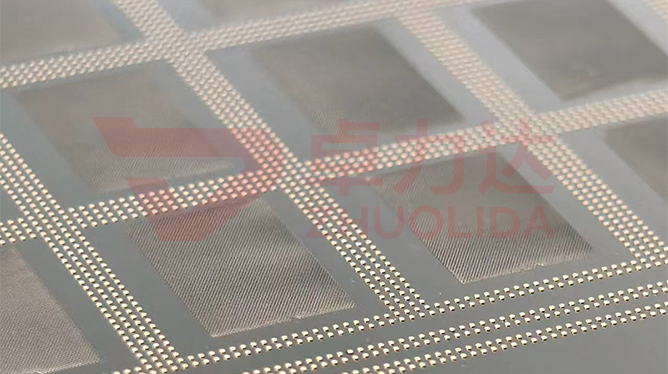
An aperture passes light through one clean rim, and a 20 μm fine rib chips at the slightest touch. Electroformed aperture edge burr control governs whether surplus nickel grows at the opening edge through the whole forming run: whether nodules form at strike, whether development undercut turns the sidewall into sawteeth, and whether the few seconds of release tear a burr at the rib foot. A burr is not measured by opening size but by whether the rim is continuous and free of lifted metal whiskers, judged on the line by side-lighting under a vision system and scanning the edge profile with flash measurement. Size the aperture as accurately as you like, and one whisker of burr still brings stray light and diffraction fringes into the image, so edge integrity counts for nothing.
The trap on the line is treating burrs as a cosmetic flaw to wipe off downstream. On one lot of fine-rib apertures, release started from a high-stress corner and the 20 μm ribs were pulled at an angle, flipping up a fine burr at the foot; a flat-bed checker scanned every opening dimension as passing, yet side-lighting after mounting showed a ring of bright specks. On a rushed lot the brightener was overdosed and current density pushed to the upper limit, so nickel grew nodules along the rib edges and hardness climbed to 550 Hv, brittle enough to crumble into sawteeth the moment it was lifted. More hidden still, over-strength developer bit a micro-undercut into the resist sidewall, which copied onto the nickel as a row of steps that could neither be wiped nor polished away. None of these failures appear in a 20 μm line-width re-check, and by the time imaging finds them a dozen sheets from one bath are usually scrap. Electroformed aperture edge burr control is hard to put into practice precisely because the burr is born in the instant of release, which upstream dimensional inspection simply cannot stop.
Parameter Window
• Fine rib width: 20 μm; the finer it is, the more it fears tearing and nodules
• Current density: 1–4 A/dm², running the upper end tends to grow edge nodules
• Nickel-cobalt hardness: 450–550 Hv; too hard turns brittle and chips into burrs
• Wall roughness: ≤0.01 μm; a smooth sidewall is less likely to hold a burr
• Development undercut: control concentration and time, a few tenths of a micron already becomes a step
• Edge integrity: side-light sampling, with burr height limits banded per ring
Manufacturing Process (8 Steps)
1. Master design — mark the release direction in fine-rib zones, avoiding right-angle roots that tear easily.
2. Substrate pre-treatment — clean and make conductive, passivating the mandrel face to suppress strike nodules.
3. Lamination and LDI — 8 μm/8 μm resolution and ±5 μm double-side alignment set the resist sidewall straight first.
4. Development — control concentration and time so no residue stays at the rib foot and the wall is not undercut.
5. Electroforming — staged control of 1–4 A/dm² so the edge grows no nodules and the grain stays fine.
6. Demolding — slow one-piece release from a low-stress corner, with the 20 μm ribs loaded along their length.
7. Deburr and inspection — micro-treatment after a low-temperature anneal, side-light the rim under a vision system.
8. Packing and release — store blades separated, with an edge-integrity sampling record attached.
Core Advantages
1. Clean rim — electroformed aperture edge burr control fixes the release direction, so stray light drops off sharply.
2. No heavy polishing — 20 μm ribs skip mechanical buffing and do not distort or collapse at the rim.
3. Ribs do not chip — hardness and internal stress are managed together, so there is no brittle break near 550 Hv.
4. Smooth sidewall — ≤0.01 μm walls with steady development keep step burrs to a minimum.
5. Traceable — current density, brightener dosing and side-light sampling are logged per bath.
6. Easier mounting — with the edge intact, the lens group does not rework over diffraction fringes.
Typical Applications
1. Precision ring-band apertures with 20 μm fine ribs, whose rib edges fear burrs most.
2. Fixed apertures in high-resolution imaging, where bright rim specks land straight in the picture.
3. Mode-limiting laser apertures, where an edge burr throws stray diffraction.
4. Multi-ring vignetting apertures, where many rings mean a burr on any one spoils the set.
5. Double-side aligned blades, where both front and back rims have to be clean.
6. Large-panel tiled apertures, where release consistency decides whole-panel yield.
Design and Selection Notes
1. Fix the release direction first and lift along the 20 μm ribs, never across them.
2. Run current low rather than at the ceiling; slow deposition at 1–2 A/dm² grows fewer edge nodules.
3. Under-dose the brightener rather than over-dose it; at 550 Hv brittle chipping and internal stress arrive together.
4. Do not rush development; a few tenths of a micron of undercut copies onto the nickel as a step.
5. Give electroformed aperture edge burr control its own station; a flat-bed checker cannot read sidewall burrs.
6. Verify mandrel passivation per lot; nodules start where the conductive layer is uneven.
7. Pack blades separated; stacked friction can rub a second burr onto the rim.
Seen on its own, electroformed aperture edge burr control barely fills a standalone step: the resist sidewall is set straight by LDI and development, grain and nodules grow as they will in the bath, the few seconds of release decide whether a 20 μm rib is torn into a burr, and deburring only closes the loop. Edge condition follows the solution lot, brightener dosing and bath temperature, so it has to be side-light sampled per bath rather than let one clean rim speak for a whole run. What is hard on a line is not releasing one clean aperture now and then, but keeping a dozen sheets from one bath and several consecutive lots free of lifted burrs at the rib foot, with every rim drawn as one continuous line, only then do ±5 μm alignment and 20 μm line width become a clean picture. For fine-rib, multi-ring or high-resolution imaging orders, fix release direction, the current density curve, brightener dosing and development time into the process card at sampling stage; running to that card is far cheaper than wiping blades one by one downstream or reworking after mounting. On paper electroformed aperture edge burr control is a few sets of side-light photos; on the line it is the plain fact that every blade turned over shows not one bright whisker on its rim.
Contact:赖先生
Phone:+86 18938693450
Tel:0755-2708-8292
Email:yw9@zldsmt.com
Add:深圳市宝安区福永镇新和村福园一路华发工业园A3栋
 Zhuolida