Welcome: Shenzhen Zhuolida Electronics Co.TD
Language:
 ∷

∷
∷
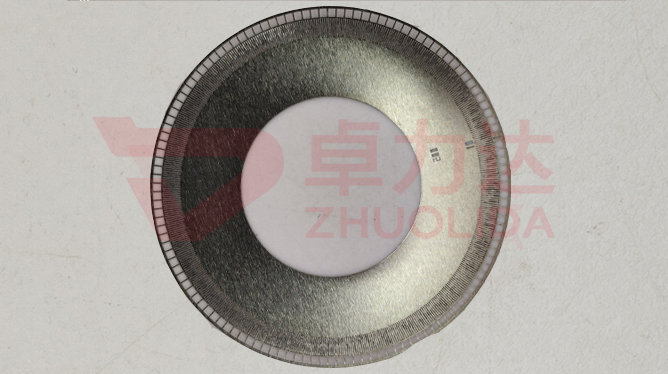
A code disc is a very thin metal disc carrying concentric rings of alternating transparent and opaque grating tracks. An optical encoder passes or reflects light through those gratings, the photodetector picks up the alternating signal, and the result becomes an angle or position reading. Resolution depends on the innermost, finest track: the narrower the line and the more tracks, the finer the division. So the whole discipline comes down to line width and edge quality.
Three things make code discs hard — the pattern must be accurate, the edges must be straight, and the disc must stay flat. The traditional route is photochemical machining: pattern the resist, then etch. But etching is isotropic. While the etchant cuts downward it also bites sideways, so the finished line comes out narrower than designed with a rounded edge, and fine lines simply etch through. Once line width drifts, encoder interpolation error follows. Laser direct writing or laser cutting can make fine lines, but leaves a heat-affected zone and dross that must be deburred, and handling a thin disc introduces stress. Electroforming takes another path: whatever pattern sits on the mandrel, the nickel grows to match. Metal is built up from the base, so sidewalls are vertical by nature and undercut does not exist.
Servo motors, robot joints, and direct-drive rotary tables have all been moving toward higher resolution in smaller envelopes. Disc diameters shrink while gratings pack tighter — a 20 µm pitch is now routine, and finer pitches are in development. As the diameter shrinks, the line-width error caused by undercut becomes a larger fraction of the pitch, and etching runs out of headroom. Electroforming has another underrated benefit: the substrate is metal. A nickel or stainless disc does not drift with temperature, resists vibration, does not build static charge, and has none of the chipping risk of a glass disc. Those two factors are why high resolution code disc electroforming has gained ground in compact, high-precision encoders.
Parameter Window
• Outer diameter: 8–100 mm, from joint modules to rotary tables
• Pitch / line width: 10–100 µm, setting theoretical resolution
• Track count: 1–20, including index and limit tracks
• Disc thickness: 20–100 µm, thin for low inertia, thick for stiffness
• Common materials: electroformed nickel, nickel-cobalt, stainless substrate
• Profile tolerance: ±3 µm; concentricity ≤ 5 µm
Manufacturing Process (8 Steps)
1. Master fabrication — photolithography or laser direct writing defines the grating pattern, fixing line width and track position.
2. Conductive treatment — a conductive layer on the master ensures uniform strike and unbroken fine lines.
3. Electroforming — nickel deposits layer by layer to fill the gaps, with thickness controlled to the target.
4. Demolding — low-stress, slow release keeps fine grating lines from stretching.
5. Center hole machining — punch or laser the center and mounting holes concentric with the grating.
6. Inspection — measure line width, track count, concentricity, and transmission ratio; reject broken or missing tracks.
7. Surface finishing — blackening or dark nickel plating as needed to cut reflection and raise signal contrast.
8. Clean packaging — anti-static clean bags, one disc per bag, to avoid scratching the grating area.
Core Advantages
1. Accurate line width — the pattern copies from the master, holding deviation across the disc to the micron level.
2. Vertical sidewalls — metal grows upward, so there is no undercut and no collapsed edge.
3. Uniform thickness — plating thickness is controllable, consistent within and between discs.
4. No warp or drift — the metal substrate is stiff enough to resist clamping distortion.
5. Temperature and vibration resistant — suits high temperature, strong vibration, and continuous duty.
6. No tooling cost — replication from a master means no stamping die, even for small varied batches.
Typical Applications
• Servo motor encoders — the core dividing element for speed and position feedback.
• Robot joint modules — small diameter and high resolution directly affect repeatability.
• CNC rotary tables and indexing heads — multi-track discs combine coarse division with fine positioning.
• Medical and infusion pumps — closed-loop micro-dosing depends on a stable disc.
• Optical scanning and galvos — reflective discs for high-speed angle feedback.
• Elevators and wind pitch systems — metal discs endure vibration-heavy environments.
Design and Selection Points
1. Derive pitch from the required resolution first, then check the photodetector's resolving limit — do not chase fineness unilaterally.
2. The innermost track is the most failure-prone; specify minimum line width and gap with real process margin.
3. Annotate center-hole to grating concentricity separately — it goes straight into interpolation error.
4. Match thickness to diameter; a large disc that is too thin warps, a small disc that is too thick will not fit.
5. Reflective discs need surface treatment; darkening noticeably widens light-dark contrast.
6. Decide the mounting method early — press fit, adhesive, or screws each imply a different flatness requirement.
7. Where oil mist or dust is present, leave clearance for a shield; do not let contamination settle on the finest track.
The real value of high resolution code disc electroforming is moving the lithographic pattern into metal unchanged — line width that does not shrink, edges that do not collapse, a disc that does not warp. Etching is limited by undercut and laser by the heat-affected zone, while electroforming avoids both in principle, which is why it is increasingly hard to replace in high-resolution, small-diameter encoders. As robot joints and direct-drive designs push further into compact high precision, optical grating disc electroforming will keep raising the accuracy ceiling. Choosing a code disc is essentially buying certainty on line width, concentricity, and long-term stability, and encoder code disc electroforming holds all three inside a single process step. For the device builder, getting the disc right saves a great deal of downstream interpolation tuning and error compensation.
Contact:赖先生
Phone:+86 18938693450
Tel:0755-2708-8292
Email:yw9@zldsmt.com
Add:深圳市宝安区福永镇新和村福园一路华发工业园A3栋
 Zhuolida