Welcome: Shenzhen Zhuolida Electronics Co.TD
Language:
 ∷

∷
∷
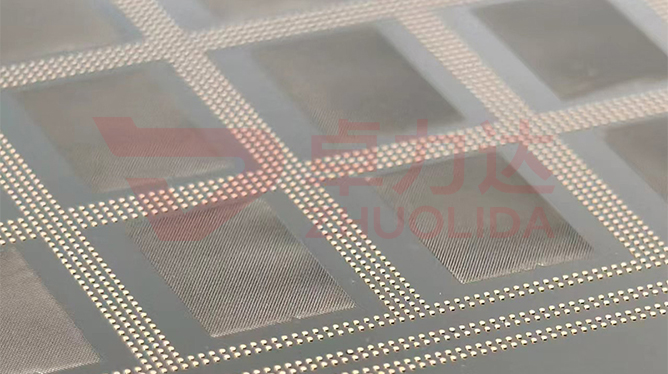
A nebulizer mesh is the core part of a vibrating mesh or ultrasonic nebulizer: a thin metal sheet carrying hundreds to thousands of micron-scale tapered holes. Driven by a piezoelectric ring vibrating at high frequency, the liquid drug is pushed through those holes and breaks into a fine mist that the patient inhales. Everything depends on the holes — small, consistent diameter, smooth walls, a well-defined taper. Get those wrong and the droplet size scatters, or holes clog and leak. Stamping or laser drilling one hole at a time struggles to balance throughput and consistency, and tends to leave burrs at the hole edge. Etching deep tapered holes struggles with sidewall verticality and depth uniformity. Electroforming inverts the approach: build a mandrel that already carries the micro-hole array, then grow nickel into the sheet around it. Hole diameter, pitch, and taper copy straight from the mandrel, the walls come out smooth by nature, and the finished mesh atomizes more steadily and lasts longer.
Pulmonary drug delivery has spread quickly — pediatric fever management, asthma inhalation, post-operative airway humidification, home nebulizer therapy — and every one of those pushes requirements on droplet size and consistency. Droplets that are too large deposit in the mouth and large airways and never reach the lung; too small and they ride back out on exhalation. What actually sets the droplet size is the size and shape of that ring of micro-holes. A slight hole-diameter deviation or an inconsistent taper and the output drifts. This is exactly where stamping and laser drilling fail: stamping is limited by tooling and material springback, so deep tapers come out poorly; laser drilling leaves a heat-affected zone, dross at the hole mouth, and an uncontrolled taper. Etching can produce micro-holes in volume, but sidewall verticality and depth uniformity in a thin sheet are hard to hold. Electroforming replicates the mandrel's microstructure, so hole diameter holds to a few microns, wall roughness reaches the sub-micron level, taper is defined exactly by the mandrel, and hole-to-hole consistency across the whole sheet far exceeds drilling hole by hole. That is what moved nebulizer meshes from usable to reliable.
Parameter Window
• Hole diameter: 3–20 µm, chosen against the target droplet size
• Hole density: 500–2000 holes/cm²; denser arrays raise output
• Sheet thickness: 30–80 µm, balancing strength and output efficiency
• Common materials: electroformed nickel, nickel-cobalt, corrosion resistant and sterilizable
• Wall roughness: Ra < 0.5 µm, lowering flow resistance and preventing hold-up
• Droplet size: holds stably in the 1–5 µm range
Manufacturing Process (8 Steps)
1. Mandrel preparation — photolithography or etching builds the tapered micro-hole master, fixing diameter, pitch, and taper.
2. Conductive treatment — a conductive layer forms on the mandrel so nickel strikes evenly into every hole.
3. Electroforming — nickel deposits layer by layer, thickening the metal between holes into a sheet.
4. Demolding — controlled-stress release avoids distorting or tearing the micro-holes.
5. Inspection — microscopy checks hole diameter, count, and edge integrity, screening out clogged or missing holes.
6. Clean and passivate — residue removal and surface passivation improve corrosion resistance and biocompatibility.
7. Assembly — bonded with the piezoelectric ring and seals into a nebulizer assembly.
8. Sterilize and pack — medical-grade sterilization followed by clean packaging for the device maker.
Core Advantages
1. Highly consistent diameter — the whole array copies one mandrel, so variation within and between parts is minimal.
2. Smooth walls — electroformed walls are slick, lowering flow resistance and resisting clogging.
3. Accurate taper — hole shape comes from the mandrel, making spray direction and droplet size controllable.
4. Corrosion resistant and sterilizable — the nickel matrix tolerates drugs and disinfection for repeated medical use.
5. Large-area micro-holes — over a thousand holes per sheet give ample output without sacrificing droplet size.
6. Cost falls with volume — one mandrel investment, amortized across replicated parts.
Typical Applications
• Medical vibrating mesh nebulizers — the core aerosol mesh; hole size sets where the drug lands.
• Ultrasonic nebulizer plates — humidifiers and therapy devices needing steady output and long life.
• Aerosol drug delivery — tight droplet control for pulmonary deposition.
• Miniature humidifiers — portable humidifiers and diffusers with fine, even mist.
• Inkjet and spray coating — micro-hole arrays as fine atomizing nozzles for uniform films.
• Beauty atomizers — fine cool mist for better absorption and skin feel.
Design and Selection Points
1. Work backward from target droplet size to hole diameter — smaller holes mean finer mist but easier clogging and higher pressure drop.
2. Match sheet thickness to hole diameter; too thick blocks output, too thin deforms.
3. Set taper direction relative to the output side — reversed taper changes spray angle and droplet distribution.
4. Control the hole-mouth chamfer; burrs and rolled edges directly coarsen the droplet size.
5. Prefer a corrosion-resistant nickel matrix where the part contacts drug and disinfection cycles.
6. Design against clogging up front — upstream filtration and no liquid traps around the hole field.
7. Hold assembly flatness; warpage breaks the seal and makes output uneven.
Electroformed nebulizer meshes hold their ground in vibrating mesh designs because they replicate a mandrel's micro-hole array into a thin metal sheet in one step — diameter, pitch, and taper all at once — and smooth walls make droplet size steadier with fewer clogs. Against stamping, laser drilling, and etching, they open a clear gap on micro-hole consistency and wall quality, while the nickel matrix covers corrosion resistance and sterilizability. As home nebulizer therapy and inhaled drug delivery keep spreading, demands on hole consistency and output stability will only rise, and the value of medical nebulizer plate electroforming becomes clearer. Choosing an electroformed nebulizer mesh means buying accurate hole size, stable aerosol, and long service life in one part — the fundamental difference from drilling hole by hole. As nebulizers shrink and droplet requirements tighten, guarding the droplet floor at the micro-hole forming step is usually cheaper than screening and reworking downstream, and better supports the reliability and consistency medical nebulizer products need.
Contact:赖先生
Phone:+86 18938693450
Tel:0755-2708-8292
Email:yw9@zldsmt.com
Add:深圳市宝安区福永镇新和村福园一路华发工业园A3栋
 Zhuolida