Welcome: Shenzhen Zhuolida Electronics Co.TD
Language:
 ∷

∷
∷
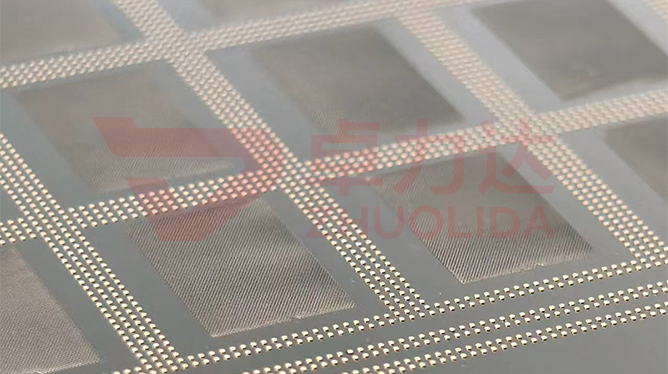
An electroformed nickel mask comes off the mandrel soft; it only goes on the tool after being stretched onto an aluminium frame and locked with AB adhesive. Electroformed mask tensioning stress control governs exactly that pull: tension flattens the foil and lengthens it in the same motion, so apertures shift outward, almost still at the centre and piling up several to a dozen microns at the edges. Tension is banded from 10–55 N and held to ±1 N, the band chosen by foil thickness and pitch — thin foils take the lower end, only thick sheets go near the top. Stretching is not the end of it; over a day of adhesive cure the stress settles to a new equilibrium and the pattern moves once more. Working out that elastic elongation and separating the drift from ±7 μm aperture position accuracy is what this control is really for.
The trap most often hit on the line is watching the force reading while ignoring where that force drags the pattern. A batch of fine-pitch masks frames up with the centre registering cleanly yet the edge apertures spread as a whole; flash measurement puts the cumulative shift past ±7 μm, and the trace shows tension pushed to the 55 N ceiling with no elastic elongation allowed for in the master data. Another lot takes the easy route at 12 N, the mask never sits flat on the board, paste bleeds out along the aperture rims and bridges, and release drags a tail. Creep is more wearing still: 24 hours after AB adhesive cures the tension has fallen a few newtons, a sheet measured in the morning no longer matches one measured the next day, and the ±5 μm double-side budget is gone. Mix two bands in one lot and the two sheets drift by different amounts, so no single compensation set works on the tool. What links these cases is treating framing as packing rather than as a dimensional step — by the time the printer sees the offset the foil is already bonded to the frame. Electroformed mask tensioning stress control is hard to apply because it owns both a force and the few microns of displacement that force creates.
Parameter Window
• Tension 10–55 N held to ±1 N, banded by foil thickness and pitch
• Stencil thickness 15–200 μm; foils under 30 μm take the 10–20 N lower end
• Aperture position accuracy ±7 μm, swept before and after framing to take the difference
• Double-side alignment ±5 μm; uneven stretch eats this margin first
• Maximum substrate 610×660 mm; wider spans show larger cumulative edge drift
• Nickel-cobalt alloy hardness 450–550 Hv; a harder foil leaves less plastic margin
Manufacturing Process (8 Steps)
1. Band setting — fix the band by thickness and pitch, thin foils near 10–20 N, thick ones toward 40–55 N.
2. Demold and flatten — release the foil from a low-stress corner, low-temperature anneal to shed deposition stress.
3. Baseline read — sweep all apertures with flash measurement before framing and store the unloaded coordinates.
4. Frame alignment — centre the mask on the aluminium frame, pre-pull four corners, bring marks onto the frame datum.
5. Banded tensioning — ramp force in steps to the set band, held to ±1 N, all four edges together rather than one side leading.
6. AB adhesive cure — coat and let it set under controlled temperature and humidity so tension spreads evenly through the foil.
7. Re-tension and re-measure — re-check after 24 hours of cure, top up any drop beyond 1 N, then sweep the pattern again.
8. Inspection and packing — checker re-verifies apertures, tension band and drift logged per sheet before shipping.
Core Advantages
1. Drift becomes calculable — electroformed mask tensioning stress control isolates elastic elongation, so master compensation has a basis.
2. Sheet-to-sheet match — one band per lot keeps a dozen sheets inside the same position spread.
3. Alignment margin kept — ±5 μm double-side alignment is not quietly consumed by creep.
4. Flat contact — a properly banded mask sits tight, so paste does not bleed and release does not tail.
5. Foil spared — thickness-based bands keep thin foils out of plastic deformation or cracking.
6. Traceable — tension band, re-tension record and the before/after coordinate delta are stored per sheet.
Typical Applications
1. Mini LED and BGA fine-pitch printing stencils, least able to absorb edge drift.
2. WLP ball-placement templates for 4–12 inch wafers, where a million apertures demand whole-sheet agreement.
3. Ball and Flux stencils for ABF substrates, whose double-side alignment leans on stable tension.
4. 610×660 mm photovoltaic grids, where a long span makes cumulative edge shift a separate calculation.
5. Precision grading screens for semiconductors, whose assembly holes are calibrated to the tension band.
6. Composite stencils with local thickening, where steps concentrate stress and make banding matter more.
Design and Selection Notes
1. Fix the band by thickness first; never pull a 15–30 μm foil past 40 N.
2. Allow elastic elongation in the master data rather than patching compensation after framing.
3. Give AB adhesive its full cure — do not judge dimensions before the 24-hour creep has run out.
4. Pull all four edges together; one side leading skews the pattern into a one-way slant.
5. Sweep with flash measurement before and after framing; re-frame anything whose delta exceeds ±7 μm.
6. Use one band per lot and one compensation set per band, never ship them mixed.
7. Put low-temperature anneal before framing so deposition stress does not enter the stretched state.
Seen on its own, electroformed mask tensioning stress control sits between demolding and packing and looks like a matter of muscle, when it is really a dimensional step: the foil modulus is set by deposition and anneal, the tension band by the process card, and the twenty-odd hours of AB adhesive cure quietly reset the equilibrium once more. Get any one stretch wrong and the before/after delta from the flash measurement stops making sense. What is hard on a line is not pulling one sheet to a handsome 40 N reading, but holding cumulative edge drift from a dozen sheets of one bath, across several consecutive lots, inside the same band — only then is ±7 μm position accuracy more than a number on paper. For orders with a hard whole-sheet position requirement, write the thickness-to-band table, master pre-elongation, cure time and re-tension threshold into the process card at sampling and run to that card in production; it is far cheaper than endlessly retuning release speed and trial-and-error compensation at the printer. On paper electroformed mask tensioning stress control is a few newtons and one drift curve; on the line it is the fact that every aperture stays at the coordinate it was designed for after the foil is pulled tight.
Contact:赖先生
Phone:+86 18938693450
Tel:0755-2708-8292
Email:yw9@zldsmt.com
Add:深圳市宝安区福永镇新和村福园一路华发工业园A3栋
 Zhuolida