Welcome: Shenzhen Zhuolida Electronics Co.TD
Language:
 ∷

∷
∷
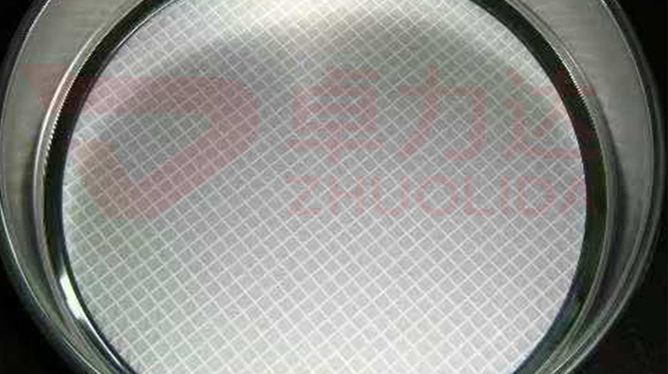
Electroformed microhole mesh open-area ratio control governs what share of the whole mesh face the holes take up, and how that share is matched to mesh stiffness. Open area is set by aperture, pitch and web together: at the same ± 3 μm aperture, pack the array a little denser and the ratio climbs, the remaining nickel ribs grow thinner, and the sheet starts behaving like soft gauze. The line works in 15–45% bands — low-ratio sheets are stiff and suit support and aperture parts, high-ratio sheets are open and suit screening and filtration, yet tension up at 55 N easily wrinkles or collapses an edge. It cannot be settled as an area fraction alone; thickness, rib width and framing tension all have to sit in the same calculation, or the drawing looks open and the sheet deforms once it is on the frame.
The pit stepped into most often is pushing a filtration sheet to the top of the ratio band: aperture unchanged, pitch pulled in close to 120 μm, and the mesh ends up too soft to tension flat — switch to a higher band within 10–55 N and the whole sheet balloons, the AB adhesive seam cracking first. Another lot of support mesh had the ratio pressed too low and the web left too wide, so throughput fell short; the customer had to raise pressure drop, and after a few flushes the fine ribs broke from fatigue. Then there is uneven zoned density: dense in the middle, sparse at the rim, every single hole passing on the vision system, yet after framing stress collects entirely at the density boundary and that ring lifts first after low-temperature annealing. None of these are caught by ± 3 μm aperture accuracy; the trouble is density and stiffness never being calculated together, and by the time throughput or flatness is accepted the sheet is glued fast in the frame. Once the ratio is fixed, rib width and thickness have little room left — change one and the other two have to move with it, and any sum skipped on the drawing is paid back in full at the tensioning bench.
Parameter Window
• Open-area ratio 15–45% in bands; a high-flow sheet at the upper end needs added thickness or lower tension in step
• Pitch ≥ 120 μm, web ≥ 50 μm, minimum aperture ≥ 25 μm; these three set the density
• Aperture accuracy ± 3 μm, position accuracy ± 7 μm, roundness ± 0.002 mm
• Stencil thickness 15–200 μm; a thin high-ratio sheet leans on rib width for stiffness
• Tension 10–55 N (± 1 N internal control), banded to the open-area ratio, never mixed
• Nickel alloy hardness 450–550 Hv; hardness and rib width together set mesh stiffness
Manufacturing Process (8 Steps)
1. Array design — back out aperture and pitch from the target ratio, ease the dense-to-sparse transition separately.
2. Master drawing — issue the LDI artwork, mark zone density and rib width clearly.
3. Lamination and LDI — 8 μm/8 μm resolution and ± 5 μm double-side alignment; the array takes shape here.
4. Development — control undercut, no residue and no thinning in fine-rib zones; rib width is the base of stiffness.
5. Electroforming — staged current at 1–4 A/dm², deposition time set by ratio on thick stock.
6. Demolding — release the whole sheet from a low-stress corner; a high-ratio sheet collapses an edge most easily at lift-off.
7. Inspection — vision and flash systems measure aperture and roundness, checker computes whole-sheet open area.
8. Framing and packing — AB adhesive frame, tension set to the 10–55 N band matching the ratio.
Core Advantages
1. Open and stiff together — electroformed microhole mesh open-area ratio control matches thickness and rib width by band, so even a high-flow sheet does not collapse.
2. No ballooning under tension — tension banded to the ratio, so 55 N high band neither wrinkles the sheet nor cracks the adhesive seam.
3. Predictable throughput — array density calculated right, so pressure drop and flow match the drawing.
4. Stress does not pile at the rim — density transition eased, no lift at the boundary after anneal.
5. Dimension and stiffness handled apart — ± 3 μm apertures to the checker, flatness to the tensioning bench, so a fault localises to the design band.
6. Traceable — ratio band, pitch and tension band logged per sheet, back to the master revision.
Typical Applications
1. Precision screens for semiconductor material grading, where the ratio sets throughput.
2. Microhole meshes for filtration and atomising, where a high-ratio sheet buys stiffness through added thickness.
3. Thin parts such as optical apertures and encoder discs, where a low ratio holds flatness and 20 μm ribs.
4. Distribution plates for batteries and fuel cells, where array density rewrites the flow field directly.
5. Support layers for Mini LED printing stencils, where ratio and tension have to be set together.
6. Large-format photovoltaic grids, where uneven zone density balloons the long edge first.
Design and Selection Notes
1. Set the ratio from throughput first, then thickness from the ratio; do not fill the sheet with holes and only then think about stiffness.
2. Do not pack pitch tight against the 120 μm floor; soften the fine ribs and 55 N tensioning shows it at once.
3. Ease the transition at density boundaries; stress concentrates hardest at a density step.
4. A thin high-ratio sheet is better off a few microns thicker than leaning on lower tension to hold flatness.
5. Verify roundness ± 0.002 mm together with aperture ± 3 μm; let the hole shape drift and the effective area changes.
6. Band tension to the ratio and never mix bands in a lot, or flatness will not match.
7. For sheets with locally densified zones, keep release and tensioning direction clear of the density step root.
Taken apart, electroformed microhole mesh open-area ratio control reads more like a design job than a plating job: aperture, pitch and web compute the area fraction, rib width and thickness carry the stiffness, framing tension is banded on top, and let any link slip and the sheet that looked open on the drawing balloons or lifts once it is on the frame. ± 3 μm aperture accuracy only guarantees each single hole; it cannot say whether hundreds of thousands of holes packed together leave a stiff face. Tuning density band against tension band often does more than swapping a whole tank of solution. What is hard on the line is not turning out one high-ratio sheet, but holding flatness and throughput in the same band across several consecutive lots and several density bands, so the customer is not forever readjusting pressure drop. For orders with hard requirements on both throughput and flatness, fix the ratio band, pitch, thickness and tension band into the process card at sampling stage and run to that card in production; it is far cheaper than endlessly patching adhesive and flattening at the tensioning bench. On paper electroformed microhole mesh open-area ratio control is one percentage; on the line it is the even feel of a sheet that, once tensioned, lets flow through and still lies flat.
Contact:赖先生
Phone:+86 18938693450
Tel:0755-2708-8292
Email:yw9@zldsmt.com
Add:深圳市宝安区福永镇新和村福园一路华发工业园A3栋
 Zhuolida