Welcome: Shenzhen Zhuolida Electronics Co.TD
Language:
 ∷

∷
∷
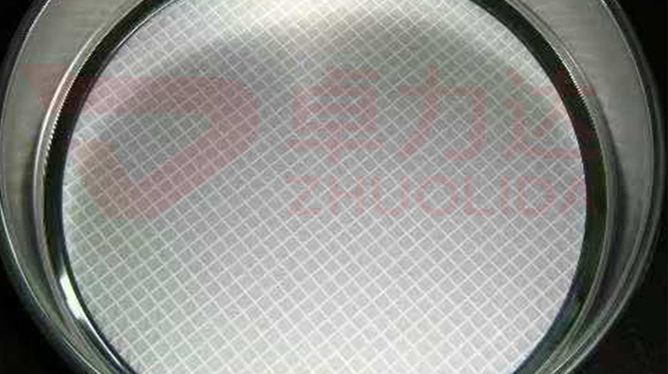
Precision nickel mesh coating adhesion control governs how firmly the interface bonds, both between the nickel layer and the mandrel and between the build-up layer and the strike layer. An electroformed nickel mesh first grows a thin nickel skin on a conductive mandrel, then that strike layer carries the whole sheet up to 15–200 μm; leave an oxide film or a trace of resist at the interface and adhesion shrinks to little more than mechanical interlock. The floor judges it with a 180° bend, tape peel and a cross-hatch cut, and whether there is a tearing sound at release or a lifted edge after bending shows trouble sooner than any number off a tensile tester. Adhesion is not a case of thicker plating being stronger: the activation state in the first few tens of seconds of strike sets the base for the whole sheet, and no upstream current catch-up can rescue a face that was never activated open.
The case the line runs into most often is corners of sheets from one bath blistering first, a fingernail scrape exposing the bright mandrel face — once the activation bath ages, nickel never nucleates in the low-current zone and merely floats on the oxide film. Another lot of 25 μm thin mesh passed every aperture at ± 3 μm on the checker, yet tensioning to 55 N tore the whole length open along the AB adhesive seam; section it and the interface is as flat as two sheets of paper laid together. More troublesome still is a ball-placement stencil with local thickening, where a dark line surfaced between the build-up layer and the original nickel after low-temperature annealing and only cracked open at that line after a few thousand prints. None of these failures make it into the dimensional report; by the time assembly finds them a whole batch of frames is already glued fast, and rework means scrapping frame and sheet together.
Parameter Window
• Strike current density 1–2 A/dm² for low-current nucleation, raised to 1–4 A/dm² for normal deposition
• Activation-to-bath interval ≤ 30 s; overrun means re-wash and re-activate to stop the mandrel face passivating again
• Nickel mesh thickness 15–200 μm; stock under 30 μm is most sensitive to interface defects
• Nickel-cobalt alloy hardness 450–550 Hv, hardness set by alloy ratio rather than forced with brightener
• Aperture accuracy ± 3 μm and position accuracy ± 7 μm, rechecked separately from adhesion
• Tension 10–55 N (± 1 N internal control); the interface carries continuous shear after framing
Manufacturing Process (8 Steps)
1. Mandrel preparation — polish the stainless or silicon mandrel to spec, hold surface roughness down first so the interface hides no oxidation spots.
2. Degreasing and cleaning — alkaline degreasing with ultrasonics carries rolling oil and fingerprints right off; residual oil is the number one source of peeling.
3. Acid activation — a short etch in dilute sulphuric acid or a dedicated activator exposes fresh metal, time banded to the mandrel material.
4. Rinse and live entry — after a pure-water rinse, enter the bath live within 30 s, no second passivation in air.
5. Low-current strike — lay down one continuous thin nickel skin slowly at 1–2 A/dm², fill the nucleation sites before any build-up.
6. Build-up electroforming — raise current to 1–4 A/dm², control bath temperature and nickel-cobalt ratio, watch internal stress as it deposits.
7. Demolding and low-temperature anneal — release the whole sheet from a low-stress corner, then anneal to let the interface stress go.
8. Inspection and framing — sample adhesion by bend, peel and cross-hatch, checker scans openings, frame in 10–55 N bands.
Core Advantages
1. No peeling — precision nickel mesh coating adhesion control binds activation and strike into one continuous operation, and a 180° bend sheds no layer.
2. Resists framing shear — the interface is a metallurgical bond, not a mechanical lay-up, so 55 N tension does not tear the frame adhesive seam.
3. No delamination in build-up — locally thickened ball-placement stencils show no dark line after anneal and push print life toward 15000 cycles.
4. Thin stock steady too — 15–30 μm foil skips heavy polishing, so mechanical handling introduces no microcracks.
5. Dimension and interface handled apart — ± 3 μm apertures belong to the checker, adhesion to the peel station, so a fault reaches back to the bath.
6. Traceable — activator lot, strike current curve and anneal furnace run logged per sheet, back to the specific mandrel.
Typical Applications
1. Mini LED and BGA fine-pitch printing stencils, where thin foil has zero tolerance for interface peeling.
2. 4–12 inch WLP ball-placement stencils with local thickening, where interlayer bond strength is a hard requirement.
3. Ball and Flux stencils for ABF substrates, where framing tension is high and the interface takes continuous shear.
4. Precision screens for semiconductor material grading, where repeated cleaning and remounting test bond strength.
5. Thin parts such as optical apertures and encoder discs with 20 μm ribs, where one passivated mandrel face scraps the whole sheet.
6. Large-format photovoltaic grids, where uneven activation along the long edge blisters the two ends first.
Design and Selection Notes
1. Change the activator by sheet count, not by calendar; iron and chromium ions collect in aged solution and nucleation density drops straight off.
2. Lock the activation-to-bath window at 30 s; do not leave work standing on a transfer rack to save one rinse.
3. Strike slow rather than fast. If the first skin is not continuous, the thicker the later 1–4 A/dm² build-up, the larger the internal stress.
4. Verify the mandrel passivation layer by peel test each lot; uneven conductive spots always blister first.
5. Watch nickel-cobalt ratio and hardness together; do not trade adhesion for hardness pushed to 550 Hv with brightener.
6. Band the low-temperature anneal temperature to thickness; over-firing thin stock coarsens the interface grain instead.
7. For sheets with build-up or step structures, keep the release direction clear of the interlayer step root.
Laid out, precision nickel mesh coating adhesion control has almost no standalone step that can make it good again: the mandrel face is settled in the few minutes of degreasing and activation, the first tens of seconds of strike decide whether nucleation fills the surface, and release and anneal each shift the interface stress once more. Let any stretch slip and bend peeling hides underneath a dimensionally clean report. What is hard on the line is not turning out one well-bonded sheet now and then, but keeping a dozen sheets from one bath and several consecutive lots, with activator concentration and strike current all in the same band — only then does ± 3 μm aperture accuracy have a base to stand on. For orders with a hard bond-strength requirement, fix degreasing time, activator life, bath-entry interval and the strike current curve into the process card at sampling stage and run to that card in production; it is far cheaper than patching things up over and over at framing and printing. On paper precision nickel mesh coating adhesion control is a string of parameters; on the line it is the crisp sound as each sheet lifts off the mandrel and the edge that stays down after a bend.
Contact:赖先生
Phone:+86 18938693450
Tel:0755-2708-8292
Email:yw9@zldsmt.com
Add:深圳市宝安区福永镇新和村福园一路华发工业园A3栋
 Zhuolida