Welcome: Shenzhen Zhuolida Electronics Co.TD
Language:
 ∷

∷
∷
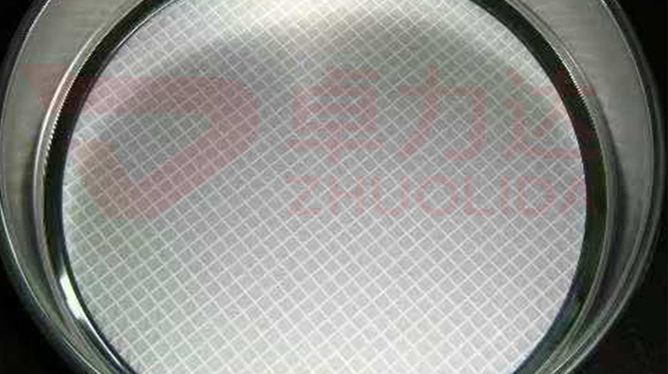
Precision nickel mesh surface warpage control governs whether a thin electroformed sheet lies flat once it leaves the mandrel. A 15 μm nickel mesh is thin enough to transmit light, and the slightest unevenness in grain, brightener or current density banks residual stress inside it; the moment release drops the mandrel constraint that stress bows the mesh into waves or curls a corner. Thin stock creases at one press and is scrap at one crease, so warpage has to be dissolved back at deposition and annealing. Nickel mesh residual stress relief rests on staged current to steady the grain, low-temperature annealing to let the stress go, and banded tension to pull the sheet flat, and skip any one of the three and some spring-back stays. Electroformed thin mesh warpage recheck sweeps flatness with a vision system and reads corner lift with a flash measurement system; delivery is judged in the tensioned state, not as a bare sheet lying on the bench.
The most frustrating case on the line is a bare sheet that measures flat and then bows as soon as it is tensioned. On a 15 μm screen mesh, flatness passed with the sheet laid on a plate after release, but once AB adhesive went onto the frame and tension reached 30 N a wave rose in the middle; the squeegee rode air over that stretch and deposit volume swung high and low, and stripping it down showed current density high at the front of the run and low at the back, so internal stress never matched end to end. On another lot of microhole mesh it shipped flat, then two weeks in stores left corners curled two millimetres when it went on the machine; aperture recheck had not moved, and the trail led to a low-temperature anneal set too cool so the stress never fully let go. More common still is blaming warpage entirely on release technique: change the lift angle again and again, the sheet curls a little less, and ± 3 μm aperture accuracy wanders with it. None of these appear in an aperture recheck, and by the time the printer reports an uneven sheet a frame is usually already tensioned. Precision nickel mesh surface warpage control is hard to put into practice because it governs the shape after tensioning; bare-sheet data do not count, and it has to be measured in the loaded state.
Parameter Window
• Mesh flatness rechecked in the tensioned state; corner lift on a 15 μm thin sheet ≤ 1 mm
• Current density 1–4 A/dm², ramped in stages with front-to-back difference ≤ 0.5 A/dm² so stress matches end to end
• Stencil thickness 15–200 μm; the warpage-sensitive range sits in the 15–30 μm thin band
• Nickel alloy hardness 450–550 Hv; watch internal stress when raising hardness, do not force it with brightener
• Low-temperature anneal set by nickel layer thickness in both temperature and time, stress fully relaxed, no room-temperature spring-back
• Tension 10–55 N, ± 1 N internal control, set in bands to pull the sheet flat on the frame
Manufacturing Process (8 Steps)
1. Artwork editing — issue the aperture drawing, flag flatness and tension requirements separately for the 15 μm thin band.
2. Pre-treatment — clean and make the substrate conductive, passivate the mandrel face, patch any uneven conductive layer first.
3. Lamination and LDI — imported LDI exposure at 8 μm/8 μm resolution and ± 5 μm double-side alignment; openings take shape here.
4. Development — control concentration and time so no residue stays at the foot, and hold wall roughness ≤ 0.01 μm in the same pass.
5. Electroforming — ramp current density at 1–4 A/dm² and bath temperature in stages, steady the grain and even out stress.
6. Demolding and low-temperature anneal — release the whole sheet, then anneal to a temperature and time set by thickness until residual stress is fully relaxed.
7. Inspection — vision system sweeps tensioned flatness, flash system measures corner lift, apertures rechecked at ± 3 μm.
8. Framing and packing — aluminium frame bonded with AB adhesive, tension set in 10–55 N bands at ± 1 N internal control.
Core Advantages
1. No bulge under tension — take precision nickel mesh surface warpage control into the loaded state, and a 15 μm thin sheet does not throw a wave in the middle.
2. No flattening needed — stress is let go in the anneal, so thin stock skips mechanical pressing that would crease an edge or bruise a hole.
3. No spring-back on the shelf — anneal fully relaxed, corners stay flat even after two weeks in stores.
4. Apertures hold — flatness is not forced out of release technique, so ± 3 μm aperture accuracy is not dragged off by the pull.
5. Traceable — current ramp curve and anneal temperature logged per bath, so warpage reaches back to the run.
6. Banded tension — 10–55 N in bands at ± 1 N internal control, so one lot matches the trial record.
Typical Applications
1. 15 μm precision screens and microhole meshes, where the thin band leans hardest on stress relief.
2. Mini LED and BGA fine-pitch printing stencils, where one bulge lifts the squeegee off the sheet.
3. Large-format grids such as photovoltaic stencils, where whole-sheet flatness sets print consistency.
4. Precision screens for semiconductor material grading, roundness ± 0.002 mm checked alongside mesh flatness.
5. Ball and Flux stencils for ABF substrates, where warpage drifts solder volume zone by zone.
6. Composite stencils with post height or local thickening, where stress concentrates at the step and curls first.
Design and Selection Notes
1. Set the anneal band by thickness first. Give a 15–30 μm thin sheet enough temperature and enough time, do not just go through the motions.
2. Hold the front-to-back current difference to ≤ 0.5 A/dm²; one end high and the other low and the internal stress will never match.
3. Under-dose the brightener rather than over-dose it; push hardness to 550 Hv and internal stress and warpage rise together.
4. Recheck flatness in the tensioned state; a bare sheet lying flat on a plate does not count.
5. Fix the release direction and stop re-tweaking the angle; pulling for flatness drags the apertures off.
6. Set tension in 10–55 N bands and never mix bands in a lot, or mesh state will not match the trial data.
7. Give the AB adhesive full cure time; apply tension before it sets and the frame edge pulls a local wave into the sheet.
Seen on its own, precision nickel mesh surface warpage control barely occupies a standalone step: the grain that grows in the bath decides how stress banks up, the low-temperature anneal decides whether it fully lets go, and release and tensioning decide whether the sheet stays pulled flat or bows into a wave. Pre-treatment, exposure, deposition and stripping each own a stretch of it, and let any one slip and a 15 μm thin sheet curls toward that side. What is hard is not turning out one bare sheet that happens to lie flat now and then, but keeping several sheets from one bath and several consecutive lots, framed and sitting in stores for a spell, all landing in the same band — only then does ± 3 μm aperture accuracy mean anything. For fine-pitch printing and precision screening orders accepted on squeegee contact, fix the current ramp curve, anneal temperature and time, tension band and release direction into the process card at sampling stage; it is far cheaper than endlessly retuning squeegee pressure at the printer. On paper precision nickel mesh surface warpage control is a string of parameters; on the line it is the simple fact that every 15 μm thin sheet, once framed, can finish the job lying flat.
Contact:赖先生
Phone:+86 18938693450
Tel:0755-2708-8292
Email:yw9@zldsmt.com
Add:深圳市宝安区福永镇新和村福园一路华发工业园A3栋
 Zhuolida