Welcome: Shenzhen Zhuolida Electronics Co.TD
Language:
 ∷

∷
∷
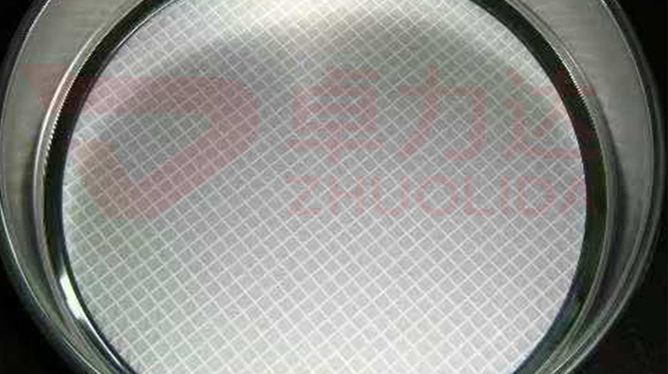
Precision nickel mesh blanking burr control governs two things: whether the cut edge is clean when the outline is blanked, and whether the ring around each aperture mouth has been torn into a rollover or a nick. An electroformed nickel mesh is grown, not cut, so the holes are already formed and blanking only has to part the sheet from the full panel along the outer frame; let the blade dull or the clearance open up and the collapsed burr folds back along the cut edge into the aperture zone. A 25 μm foil suffers most — thin stock and narrow webs, so a little too much blanking stress drags the fine ribs at ≥ 50 μm web spacing out of line. Burr height and aperture-mouth collapse are usually measured apart: the first jams outline fitting, the second changes the open area of the hole outright, and neither shows up inside ± 3 μm aperture accuracy.
The single biggest rework case is a row of fine bright whiskers hanging off the blanked edge; they score the AB adhesive layer as the sheet goes into the frame, and only at 40 N tension does the edge lift and refuse to flatten no matter how tension is adjusted. Another lot of grading screens looked tidy on the outline, but under the microscope a rollover curled inward around each aperture mouth, fines wedged in that lip during screening, and a few washes plugged the holes. More hidden still: a die clearance set for a 100 μm thick plate was used straight on 30 μm foil, the blade pulled microcracks into the fine ribs, solder paste seeped through to the back during printing, and the automatic stencil checker sailed through every opening as good. None of these come out of the electroforming tank; they are mechanical damage from that one blanking stroke, and by the time they reach the customer the sheet is already glued fast in the frame. Two percentage points of blade clearance change the reaction on 25 μm foil completely, and no amount of tension tuning buys it back.
Parameter Window
• Die clearance 5–8% of stock thickness, 15–30 μm thin foil at the lower end; wide clearance always rolls the edge
• Burr height ≤ 5 μm internal control on the outline cut, aperture-mouth collapse ≤ 3 μm
• Nickel mesh thickness 15–200 μm; the thinner the stock, the more sensitive it is to blanking stress
• Minimum aperture ≥ 25 μm, web ≥ 50 μm; no wide-clearance fast blanking in fine-rib zones
• Aperture accuracy ± 3 μm and position accuracy ± 7 μm, aperture mouth rechecked on its own after blanking
• Nickel alloy hardness 450–550 Hv, hardness bands matched to blade material and regrind interval
Manufacturing Process (8 Steps)
1. Layout — place blanking positions from the outline drawing, leave ≥ 2 mm safe distance between dense fine-rib zones and the cut edge.
2. Die selection — set 5–8% clearance by stock thickness, choose carbide blades banded to 450–550 Hv hardness.
3. Blade regrind — check the cutting-edge radius before the run, grind a dull blade before it goes on the press, do not wait for burrs to appear.
4. Lamination and location — apply a protective film, hold the sheet by vacuum so the aperture zone cannot shift during blanking.
5. Outline blanking — descend at a steady slow speed; thin foil would rather take one extra stroke than chase cycle time.
6. Deburring — light chemical or electrolytic micro-etch on the cut edge only, no mechanical grinding that would bruise the aperture mouth.
7. Inspection — vision and flash systems measure burr height and mouth collapse, checker rescans opening dimensions.
8. Framing and packing — AB adhesive frame, tension set in 10–55 N bands, cut edge clear of the adhesive layer.
Core Advantages
1. Clean cut edge — precision nickel mesh blanking burr control holds outline burr to ≤ 5 μm, so framing does not score the AB adhesive.
2. Intact aperture mouth — rollover and collapse handled apart, so blanking does not rewrite the open area of the hole.
3. Fine ribs stay straight — clearance set by stock thickness, narrow ribs at ≥ 50 μm web spacing are not pulled into microcracks.
4. Dimensions trustworthy — ± 3 μm aperture accuracy rechecked after blanking, so checker results match the real part.
5. No downstream grinding — burrs reined in by die and parameters, thin foil never distorted by mechanical edge dressing.
6. Traceable — regrind count, clearance band and stroke count logged per lot, so a burr traces back to the die.
Typical Applications
1. Mini LED and BGA fine-pitch printing stencils, where the blanked edge must sit flat against the frame.
2. Precision screens for semiconductor material grading, where an aperture-mouth rollover plugs holes directly.
3. Thin parts such as optical apertures and encoder discs, where edge burrs block light and spoil 20 μm rib imaging.
4. WLP ball-placement stencil outline blanking, where cut-edge stress must not carry into the thickened zone.
5. Microhole meshes for filtration and atomisation, where aperture-mouth integrity sets flow distribution.
6. Large-format photovoltaic grids, where long-edge blanking most easily leaves burrs at both ends.
Design and Selection Notes
1. Recompute clearance with stock thickness; do not copy thick-plate die settings straight onto 25 μm foil.
2. Force a regrind by stroke count; nickel alloy at 550 Hv is especially hard on blades.
3. Keep a safe distance between the blanking line and fine-rib zones, so cut-edge stress decays before it reaches the aperture mouth.
4. Run thin foil slow with extra strokes; the seconds saved by chasing speed do not cover reworking one sheet.
5. Deburr by micro-etch, not grinding; one touch of a mechanical brush wheel collapses the aperture mouth.
6. Hold the film location firmly under vacuum; a shift at the instant of blanking drags a whole row of holes off.
7. Feel the cut edge before framing; a burr scoring the adhesive found only at the tension station is already too late.
Broken down by operation, precision nickel mesh blanking burr control has little to do with the electroforming tank and sits almost entirely on that one mechanical blanking stroke: whether clearance is right, whether the blade has dulled, whether thin foil was rushed, whether deburring touched the aperture mouth. The outline edge and the aperture mouth are two separate criteria, one for frame fitting and one for open area; measure them together and ± 3 μm aperture accuracy reports a false pass. One lot of 30 μm foil had hanging whiskers on the blanked edge that went undetected, the whole tension curve went crooked after framing, and the sheet had to be prised off the frame and re-cut. What is hard on the line is not cutting one tidy sheet, but holding burr height steady at ≤ 5 μm across hundreds of sheets and several die changes, with fine ribs never pulled into cracks. For orders that demand both outline fit and aperture-mouth integrity, write the clearance band for each stock thickness, regrind interval, blanking speed and deburring method into the process card at sampling stage and run to that card in production; it is far cheaper than endlessly dressing edges and patching adhesive at the tensioning bench. On paper precision nickel mesh blanking burr control is a few clearance numbers; on the line it is a cut edge that does not catch the hand and an aperture mouth that does not curl.
Contact:赖先生
Phone:+86 18938693450
Tel:0755-2708-8292
Email:yw9@zldsmt.com
Add:深圳市宝安区福永镇新和村福园一路华发工业园A3栋
 Zhuolida