Welcome: Shenzhen Zhuolida Electronics Co.TD
Language:
 ∷

∷
∷
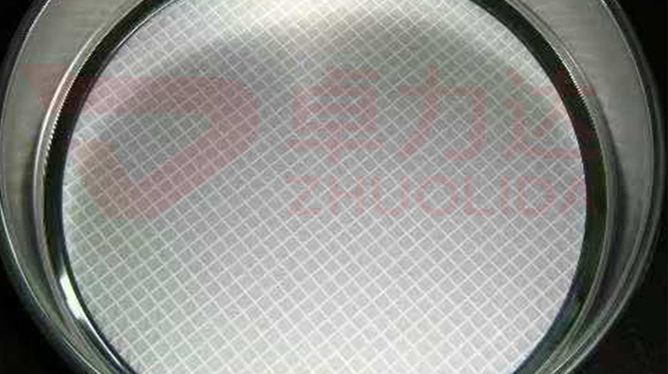
Precision nickel mesh bath purity control governs how clean the nickel solution in the electroforming tank is. A 15 μm thin mesh grows out of that solution layer by layer, so a particle a few microns across, a speck of anode sludge or some organic breakdown product drifting in the bath lands on the depositing surface and gets wrapped into the nickel as an inclusion; when the particle breaks free it leaves a pinhole. A thick foil can sometimes be covered by a later plating pass, but a 15 μm mesh is thin enough to transmit light and a pinhole goes straight through, so that one spot leaks or clogs first in screening or printing. Nickel mesh bath filtration rating is normally set in 1–5 μm filter bands, with bath circulation and scheduled tank dumps that stop particles before the bath rather than sorting finished sheets. Electroformed nickel mesh pinhole suppression rests on filtration, circulation, bath temperature and current density together; delivery scans the whole sheet for pinholes with a vision system and rechecks walls with a flash measurement system, keeping wall roughness ≤ 0.01 μm and microhole aperture tolerance ± 3 μm in the same pass.
The worst case on the line is a sheet with every aperture correct and the surface ruined. On a 15 μm microhole mesh, aperture accuracy ± 3 μm and position accuracy ± 7 μm both pass re-check, yet screening leaks fines at one small patch; magnify it and a pinhole goes clean through, traced to a filter cartridge past due on that run, with anode sludge riding the circulation onto the mesh. On a printing stencil the outgoing checker passes every opening, but bridging appears on the third board; strip it down and the wall is dotted with fine pits, sectioning shows particle inclusions wrapped in nickel that broke out at release and left craters, and paste clings in those hollows instead of releasing cleanly. More subtle still: overdose the brightener and organic breakdown products collect in the tank, the deposit looks bright, but internal stress bows the thin mesh into waves and wall roughness climbs with it. None of these show up in an aperture re-check, and by the time the printer reports paste hang-up a whole frame is usually already tensioned. Precision nickel mesh bath purity control is harder to put into practice because a pinhole is a three-dimensional inclusion: a flat-bed stencil checker at an aperture threshold cannot read a pit inside the wall, so the bath has to be logged run by run and sheets sampled one by one.
Parameter Window
• Bath filtration rating 1–5 μm in bands, cartridges replaced and logged per run
• Circulation and tank-dump intervals set per band, particle count sampled per lot
• Current density 1–4 A/dm², fine pitch at the lower end so current lines do not drag particles onto the mesh
• Stencil thickness 15–200 μm; a 15 μm mesh is the most sensitive to pinholes
• Wall roughness ≤ 0.01 μm and microhole aperture tolerance ± 3 μm, re-checked separately from pinholes
• Nickel alloy hardness 450–550 Hv; under-dose the brightener rather than over-dose it, to keep organics out of the tank
Manufacturing Process (8 Steps)
1. Bath make-up and filtration — nickel-cobalt solution passes a 1–5 μm cartridge before the tank, filter lot recorded.
2. Pre-treatment — clean and make the substrate conductive, passivate the mandrel face, leave no particles before the bath.
3. Lamination and LDI — imported LDI exposure at 8 μm/8 μm resolution and ± 5 μm double-side alignment; openings take shape here.
4. Development — control concentration and time so no residue stays at the foot; the wall profile is set here.
5. Electroforming — staged control of current density at 1–4 A/dm², bath temperature and circulation holds inclusions down.
6. Demolding — one-piece release from a low-stress corner; an inclusion most easily breaks out into a pinhole at lift-off.
7. Inspection — vision system scans the whole sheet for pinholes, flash system rechecks wall Ra, apertures re-measured at ± 3 μm.
8. Framing and packing — aluminium frame bonded with AB adhesive, tension set within a 10–55 N band before shipping.
Core Advantages
1. Pinholes held off — bring precision nickel mesh bath purity control down to cartridges and circulation, and a 15 μm mesh does not leak a spot.
2. Clean release — no particle inclusions, so walls hold less paste and fine-pitch bridging drops away.
3. No re-plating — pinholes are not covered downstream, so a 15 μm mesh skips a second deposit that would distort it.
4. Steady stress — brightener kept in check, organics do not collect, and the mesh does not bow into waves.
5. Traceable — filter lot, circulation and sampled particle count logged per bath, so a fault reaches back to the run.
6. Lot consistency — automatic stencil checker rechecks openings, wall condition sampled per bath.
Typical Applications
1. 15 μm precision microhole meshes, where thin stock has zero tolerance for pinholes.
2. Mini LED and BGA fine-pitch printing stencils, where inclusions drag out bridging.
3. Precision screens for semiconductor material grading, where a pinhole leaks material straight through.
4. Ball and Flux stencils for ABF substrates, where wall pits trap paste.
5. Large-format photovoltaic grid stencils, where whole-sheet cleanliness sets consistency.
6. Composite stencils with post height or local thickening, where step corners hide particles most readily.
Design and Selection Notes
1. Replace cartridges per run and log them; leave one past due and anode sludge rides the circulation onto the mesh.
2. Run the lower current for slow deposition; current lines pull particles toward the mesh.
3. Under-dose the brightener rather than over-dose it; breakdown products collect, the deposit looks bright and stress climbs.
4. Fix the tank-dump interval; do not wait for pits on the mesh to remember the tank needs cleaning.
5. Log pinholes per bath; passing aperture re-check does not mean the wall is free of pits.
6. Fix the release direction; an inclusion breaking out at lift-off is one through-hole.
7. Set tension within a 10–55 N band and never mix bands in a lot, or mesh state will not match the trial run.
Seen on its own, precision nickel mesh bath purity control barely occupies a standalone step: filtration decides how many particles are stopped at make-up, circulation decides whether they settle on the mesh, strike current decides whether they are dragged over by current lines, and the few seconds of release decide whether an inclusion breaks out into a pinhole. Pre-treatment, exposure, deposition and stripping each own a stretch of it, and let any one slip and a 15 μm thin mesh shows a leak first. What is hard is not turning out one clean sheet now and then, but keeping a dozen sheets from one bath and several consecutive lots with whole-sheet pinhole sampling in the same band — only then does electroformed nickel mesh pinhole suppression mean anything. For fine-pitch printing and precision screening orders judged on wall condition, fix cartridge rating, tank-dump interval, the current curve and brightener dosing into the process card at sampling stage and run to that card in production; it is far cheaper than endlessly wiping the stencil and retuning release speed at the printer. On paper precision nickel mesh bath purity control is a string of parameters; on the line it is the simple fact that no thin sheet carries the one particle the filter missed.
Contact:赖先生
Phone:+86 18938693450
Tel:0755-2708-8292
Email:yw9@zldsmt.com
Add:深圳市宝安区福永镇新和村福园一路华发工业园A3栋
 Zhuolida