Welcome: Shenzhen Zhuolida Electronics Co.TD
Language:
 ∷

∷
∷
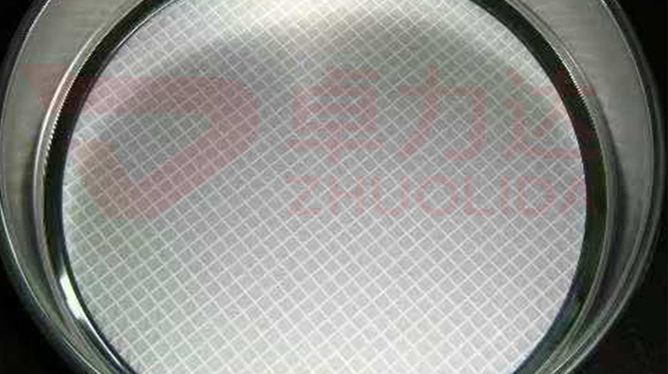
Precision nickel mesh aperture gradient forming means making apertures that differ by zone, or even grade gradually, on one and the same electroformed nickel sheet: a central zone of 30 μm fine holes does the precise screening, an outer ring of 80 μm coarse holes carries flow, and a transition band opens up step by step, all grown as one piece with no seam and no piecing. The usual alternative is to stack or piece several sheets of different aperture, and every seam leaks or clogs; a gradient mesh exists to remove that seam. LDI draws every zone onto one master in a single pass, then zoned current density lets the fine zone grow slowly and the coarse zone steadily. Nickel mesh zoned aperture design is hard not in drawing the pattern but in the fact that different apertures react differently to deposit thickness and opening shrinkage: give one uniform current to the whole bath and the fine zone seals over first while the coarse zone is still short of thickness, so aperture tolerance drifts zone by zone. Electroformed nickel mesh gradient hole recheck samples each zone on its own; a single whole-sheet mean is not acceptable.
The easiest mistake on the line is handing over a sheet judged by its mean aperture. On a grading screen the central 30 μm zone measures 29.7 μm while the outer 80 μm zone has opened to 83 μm; averaged together it still sits inside ± 3 μm, yet in screening fines slip through the rim and coarse stock jams in the transition band, and only the customer's zoned drawing makes the case stick. On a flow-control mesh the transition runs from 30 μm to 80 μm in five steps, and the third ring of holes comes out 2 μm narrower after electroforming, putting a step in the flow curve; the trail leads to a zoned current band switched too abruptly so nickel thickness never joined up. More troublesome still is making two sheets of different aperture and stacking them: the adhesive at the seam lifts under pressure, material collects in the joint after a few dozen screening runs, and cleaning cannot reach it. None of these show up in a whole-sheet mean aperture re-check, and by the time screening or flow goes wrong the mesh is usually already mounted in the machine. Precision nickel mesh aperture gradient forming is harder to put into practice because aperture is not one number but a set of them, and a flat-bed checker at a single threshold cannot read zone deviation; each zone has to be logged and rechecked on its own.
Parameter Window
• Microhole aperture tolerance ± 3 μm, sampling points set per zone, not a whole-sheet mean
• Aperture accuracy ± 3 μm and position accuracy ± 7 μm, re-checked separately from wall condition
• Minimum aperture ≥ 25 μm, pitch ≥ 120 μm, web ≥ 50 μm; the fine zone runs at the lower end
• Current density 1–4 A/dm², fine zone at 1–2 A/dm² and coarse zone at the upper end, bands switched gradually
• Stencil thickness 15–200 μm; gradient meshes run the 15–40 μm thin band, where aperture shrinkage is sharper
• LDI resolution 8 μm/8 μm, double-side alignment ± 5 μm, maximum substrate 610 × 660 mm
Manufacturing Process (8 Steps)
1. Zoned artwork — set aperture bands from the screening or flow curve, flag centre, transition and rim separately.
2. Pre-treatment — clean and make the substrate conductive, passivate the mandrel face, recheck the fine-zone conductive layer.
3. Lamination and LDI — one imported LDI exposure draws the full plate at 8 μm/8 μm resolution and ± 5 μm double-side alignment.
4. Development — control concentration and time so the fine zone keeps no residue and the transition does not undercut; apertures are set here.
5. Electroforming — zoned control of current density at 1–4 A/dm² and bath temperature, fine zone slow, coarse zone steady, bands ramped.
6. Demolding — one-piece release from a low-stress corner; the thin transition wall is most easily distorted at lift-off.
7. Inspection — automatic stencil checker set to per-zone thresholds, vision system measures apertures, flash system scans zone boundaries.
8. Framing and packing — aluminium frame bonded with AB adhesive, tension set within a 10–55 N band before shipping.
Core Advantages
1. One piece, no seam — precision nickel mesh aperture gradient forming in a single run removes the joint that stacked sheets always leak at.
2. Zones hold — ± 3 μm aperture tolerance logged per zone, so fines do not slip the rim and coarse stock does not jam the transition.
3. Continuous flow — the transition grades step by step and current bands ramp rather than step, so the flow curve stays smooth.
4. Thin stock stays stable — zoned current in the 15–40 μm band keeps the fine zone from sealing over first.
5. Traceable — sampled aperture and current band logged per zone, so a fault reaches back to the zone setting.
6. Matched tension — framing in 10–55 N bands keeps load off the fine zone across a gradient sheet.
Typical Applications
1. Powder grading screens, fine centre and high-flow rim, several size cuts from one screening pass.
2. Filtration and flow-control meshes, where an aperture gradient spreads flow instead of punching one spot.
3. Printing and coating gradient meshes, fine centre meters volume while coarse edges feed material.
4. Acoustic damping meshes, zoned apertures tuned to pass different frequency bands.
5. Precision screens for semiconductor material grading, ± 3 μm microhole tolerance rechecked per zone.
6. Large 610 × 660 mm grids, gradient apertures consistent across the sheet without piecing.
Design and Selection Notes
1. Fix the zone drawing before the bath. Write aperture count and transition width into the process card; no changes on the floor.
2. Ramp the current bands. A step like the one in the third ring usually comes from a hard current switch between zones.
3. Recheck the fine-zone conductive layer on its own; uneven conduction lets nickel seal over and leaves the hole hollow underneath.
4. Do not rush development; a few tenths of a micron of undercut in the fine zone eats the whole ± 3 μm tolerance.
5. Log rechecks per zone, never by whole-sheet mean; an average hides those 2 μm at the rim.
6. On thin stock, aim release away from the transition band and fix the lift angle; that wall is thinnest.
7. Set tension within a 10–55 N band and never mix bands in a lot, or gradient load will not match the trial record.
Laid out on the line, precision nickel mesh aperture gradient forming does not sit in any single step: aperture bands are drawn in one pass by editing and LDI, a few seconds of development decide how much the fine zone undercuts, zoned current decides whether fine holes seal over first or coarse ones come up short, and the few seconds of release decide whether the thin wall of the transition band survives. Pre-treatment, exposure, deposition and stripping each own a stretch of it, and let any one slip and the ± 3 μm aperture tolerance breaks first in one zone. What is hard is not turning out one nicely zoned sheet now and then, but keeping a dozen sheets from one bath and several consecutive lots with every zone sampling in the same band — only then is electroformed nickel mesh gradient hole recheck more than a phrase. For grading screens and flow meshes judged zone by zone, fix the zone drawing, the current switching curve, development time and release direction into the process card at sampling stage and run to that card in production; it is far cheaper than swapping meshes, retuning flow and cleaning seams after mounting. On paper precision nickel mesh aperture gradient forming is a set of parameters; on the line it is the simple fact that the whole sheet has no seam and every zone works to its own aperture.
Contact:赖先生
Phone:+86 18938693450
Tel:0755-2708-8292
Email:yw9@zldsmt.com
Add:深圳市宝安区福永镇新和村福园一路华发工业园A3栋
 Zhuolida