Welcome: Shenzhen Zhuolida Electronics Co.TD
Language:
 ∷

∷
∷
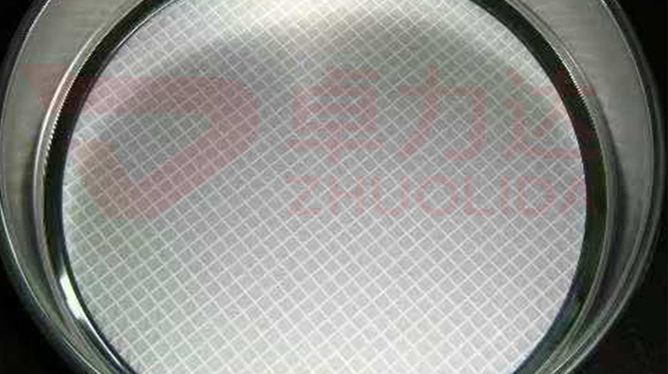
Precision nickel mesh surface roughness control is about how flat the deposit face is as grown, not a shine buffed on afterwards. Meshes run 15–200 μm thick, and the thin end is only twenty or thirty microns, so aperture edges cannot take abrasive; one pass and the opening grows a few microns. That puts the target inside the plating tank: bath chemistry, current density and filtration have to make each nickel layer come out fine and even, so the released face is already the finished surface. Skipping post-polishing sounds like saving one step, but it actually moves the whole roughness problem upstream into deposition — if the bath is not steady, there is no repair position downstream.
Floor failures are rarely a number you cannot measure; they are numbers you measure too late to fix. Overdose brightener and the grain refines, but the deposit turns brittle and internal stress climbs — the mesh curls into a tube after release, Ra reads fine yet it will not lie flat at assembly. Push current density to the 4 A/dm² ceiling and the edge burns into dendritic crystals and pits while centre and edge read two different roughness values on one sheet. Then there is filtration that falls behind: anode sludge and particles embed in the nickel as bumps, and clearing them means a polisher, yet a foil under 30 μm loses its aperture edge and the ±3 μm tolerance the moment it goes on. Precision nickel mesh surface roughness control is hard because all of these variables crowd into the same tens of minutes of deposition.
Parameter Window
• Surface roughness Ra forms directly on the deposit face with no post-polishing; aperture wall roughness target ≤0.01 μm.
• Bath current density 1–4 A/dm², held in the middle of the band; the ceiling tends to produce pits and dendritic growth.
• Stencil thickness 15–200 μm; foils under 30 μm never go on a polisher, since a rounded aperture cannot be undone.
• Minimum aperture ≥25 μm, pitch ≥120 μm, web ≥50 μm: aperture shape is held by deposition conditions, not by grinding.
• Position accuracy ±7 μm and aperture accuracy ±3 μm; the aperture gain from polishing eats the tolerance band directly.
• Nickel alloy hardness 450–550 Hv weighed together with roughness; do not add brightener just to chase hardness.
Manufacturing Process (8 Steps)
1. Artwork data — generate the master from the aperture drawing, check hole count, pitch and web, write the tolerance band into the inspection card.
2. Pre-treatment — clean and conductivise the substrate, passivate the mandrel face for low adhesion, keep particles out of the bath.
3. Lamination and LDI — imported LDI exposure at 8 μm/8 μm resolution, ±5 μm double-side alignment.
4. Development — open the windows with steep resist sidewalls, no scum, no resist narrowing the aperture.
5. Deposition — staged 1–4 A/dm² control, continuous bath filtration, brightener dosed by titration, holding Ra on the deposit side.
6. Release — peel the whole sheet from a low-stress corner, support thin zones before lifting.
7. Inspection — vision system, flash measurement and automatic checker for position and aperture, roughness tester for Ra, hardness tester for 450–550 Hv.
8. Anneal and pack — low-temperature anneal relieves residual stress, clean and pack straight away, no polishing step anywhere.
Core Advantages
1. Intact apertures — polishing-free forming keeps wall and rim as deposited, the most direct gain of precision nickel mesh surface roughness control, so paste and powder release cleanly.
2. Tolerance holds — ±3 μm aperture accuracy is not eroded by a grinding gain, one inspection pass decides the sheet.
3. Thin foils viable — the 15–30 μm band stops being scrapped for downstream processing, lifting yield noticeably.
4. Stress contained — brightener dose is capped alongside hardness, so internal stress stays inside the 450–550 Hv window.
5. Batch consistency — current curve and filtration state logged per bath, Ra distribution across one lot stays tight.
6. Shorter route — no polishing or cleaning line, faster delivery and one fewer chance to scratch the face.
Typical Applications
1. Precision screens for semiconductor material grading, where a rounded aperture on a thin foil skews the grading curve.
2. BGA and Mini LED fine-pitch printing stencils, where wall finish decides whether solder paste releases cleanly.
3. Wafer-level ball-placement masks with over a million openings, where no polishing step could ever treat holes one by one.
4. Nebuliser plates and micro-hole meshes with ±3 μm aperture tolerance, leaving almost no room for downstream grinding.
5. Optical aperture blades and encoder discs, whose fine ribs cannot take abrasive and must be formed in one pass.
6. Large-format photovoltaic grids, where polishing uniformity gets harder with area and only the deposit face can deliver.
Design and Selection Notes
1. Write polishing-free forming into the process card; leave no 'polish it once if needed' escape route.
2. Do not run at the current ceiling; the middle of 1–4 A/dm² is steadiest, and any push for output starts with a coupon.
3. Dose brightener by ampere-hours, not by how the bath surface looks — hardness and stress move together.
4. Set filtration rating and turnover by mesh band; particle bumps show worst on thin foils.
5. Support foils under 30 μm before release and re-measure roughness with the support on, to avoid fingerprints.
6. Record wall roughness ≤0.01 μm separately from surface Ra, they are not the same measurement point.
7. Fix current curve, dosing cycle and filtration state at sampling stage, then release to that card.
Put precision nickel mesh surface roughness control back on the whole line and it is really trading upstream steadiness for a downstream omission. Clean bath gives 'no bumps grow', steady current gives 'no burnt edges', restrained brightener gives 'brittle-free and curl-free'. Only then can roughness be set on the deposit face with no polishing allowance left. What separates capable lines is rarely whether Ra can be buffed to a number, but whether a dozen sheets from one bath all skip the polisher after release. For orders specifying polishing-free electroformed nickel mesh, fix the current curve, dosing cycle and filtration state at sampling stage and run to that card, cheaper than sorting and reworking afterwards. That is where precision nickel mesh surface roughness control earns its keep — choosing to build the finish inside the bath.
Contact:赖先生
Phone:+86 18938693450
Tel:0755-2708-8292
Email:yw9@zldsmt.com
Add:深圳市宝安区福永镇新和村福园一路华发工业园A3栋
 Zhuolida