Welcome: Shenzhen Zhuolida Electronics Co.TD
Language:
 ∷

∷
∷
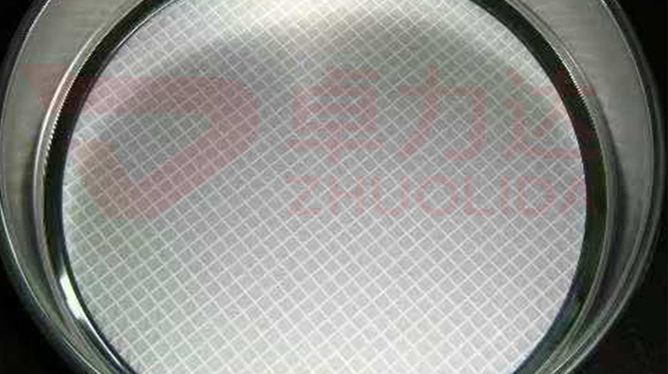
Screening a fine powder does not suffer from poor separation so much as from holes that quietly stop passing material after half an hour. Electroformed screen anti-clogging forming process addresses exactly that: the micro-hole is tapered, small at the feed face and slightly larger at the discharge face, and paired with a nickel wall finished to Ra ≤ 0.01 μm, so a particle that clears the entrance can only travel outward and cannot bridge inside the bore. It is a different matter from ±3 μm aperture accuracy — a straight wall can be dead on size and still trap an irregular grain, a little static or a hint of moisture halfway down. Discharge conditions come from taper and wall roughness together, and 25 μm class micro-holes lean hardest on those two; simply opening up the aperture throws the cut size away.
Clogging shows up on the line in three familiar forms. The first is bridging: lithium iron phosphate runs twenty minutes and throughput halves, yet under the microscope a 30 μm aperture is intact and a few near-spherical grains are packed together in the bore, a straight wall leaving them no room to give, so the plug grows denser. The second is wall build-up: switch to a slightly damp lot with wall roughness measured at 0.03 μm and fine powder coats the wall thicker and thicker until it joins into a film that even ultrasonic cleaning struggles to clear. The third is subtler, a taper cut backwards: the discharge face smaller than the feed face lets grains in but not out, the screen looks clear before mounting and blinds completely ten minutes into a run. None of these appear in a ±3 μm aperture re-check or a ±0.002 mm roundness report, and by the time they surface the sheet is usually scrap. Tapered hole discharge design has to account for wall condition at the same time; dimensions alone are not enough.
Parameter Window
• Taper: discharge face opened 3–5 μm wider than the feed face, set by D50
• Wall roughness: Ra ≤ 0.01 μm, held to 0.008 μm internally, to cut build-up
• Minimum aperture ≥25 μm, web ≥50 μm, pitch ≥120 μm
• Aperture accuracy ±3 μm and position accuracy ±7 μm, re-checked apart from taper
• Screen thickness 15–200 μm; thin-foil taper shaped by LDI at 8 μm/8 μm resolution
• Current density 1–4 A/dm², nickel-cobalt alloy hardness 450–550 Hv
Manufacturing Process (8 Steps)
1. Artwork preparation — feed-face aperture and taper from the size distribution, tapered holes on their own layer.
2. Pre-treatment — substrate cleaning and conductive coating, mandrel passivation so strike nodules do not reach the wall.
3. Lamination and LDI — double-side layered exposure at 8 μm/8 μm resolution and ±5 μm alignment; the taper comes from a dose gradient.
4. Development — control concentration and time so no residue stays on the wall and the taper transition has no step.
5. Electroforming — staged current density of 1–4 A/dm² with the bath held, grain refinement keeping wall nodules down.
6. Release — one-piece lift-off from a low-stress corner; the narrowest part of the taper scores most easily.
7. Inspection — checker for openings, vision and flash measurement for position, profiler sampling wall Ra.
8. Framing and packing — AB adhesive frame tensioned in a 10–55 N band, low-temperature annealed before shipping.
Core Advantages
1. Smooth discharge — electroformed screen anti-clogging forming process ties taper and wall finish together, so bridging falls off sharply.
2. No aperture inflation — the cut point is not sacrificed, and 25 μm micro-holes keep running.
3. Easier cleaning — at Ra ≤ 0.01 μm damp powder barely coats the wall, so back-blowing or ultrasonics restore flow.
4. Truer life — no frequent stops to shake the screen, and throughput decays more slowly across a lot.
5. Dimensions and wall tracked apart — aperture to the checker, taper and Ra to the profiler, so a fault pins to a bath run.
6. Traceable — current density, exposure gradient and sampled Ra logged per bath, reaching back to the solution lot.
Typical Applications
1. Fine battery-material grading, where near-spherical grains bridge most readily in a straight bore.
2. Pharmaceutical and food powder screening, where damp build-up sets batch throughput directly.
3. Precision screening of semiconductor abrasives and silica fines, where a ±3 μm micro-hole tolerance still has to resist clogging.
4. Chemical catalyst screening, where charged fines are fussy about both taper and wall.
5. Metal powder recovery screens for 3D printing, spherical-heavy feeds that discharge more steadily through a taper.
6. Large rotary screen decks, where throughput decay usually starts at a few locally blocked holes.
Design and Selection Notes
1. Measure D50 and grain shape first, then set the taper; near-spherical powders take the upper end.
2. Never reverse the taper — the discharge face must exceed the feed face, or you have fitted the grains with a one-way valve.
3. Give wall roughness its own station; a flat-bed checker cannot read taper Ra or a transition step.
4. Do not rush development; a few tenths of a micron of undercut becomes a ledge that catches grains on the nickel wall.
5. Run 1–2 A/dm² slow deposition; once grain coarsens, Ra ≤ 0.01 μm will not hold.
6. Do not polish foils under 30 μm downstream; buffing the taper grinds the discharge angle away.
7. For damp-material orders write the moisture barrier and back-blow cycle into the process card, not onto the screen alone.
Seen on its own, electroformed screen anti-clogging forming process is not a coating added afterwards — the three-dimensional shape of the hole is fixed at exposure: the LDI dose gradient sets the taper angle, development decides whether the transition has a step, the grain decides how smooth the wall is, and the few seconds of release decide whether the narrowest throat picks up a burr. Let any one of those slip and grains find a place to bridge. What is hard on a line is not turning out one screen that does not clog, but keeping a dozen sheets from one bath and several consecutive lots inside the same taper and Ra band — only then does ±3 μm aperture accuracy mean anything. For orders with a hard requirement on throughput decay, fix the exposure gradient, development time and current-density curve into the process card at sampling stage and run to that card; it is far cheaper than endlessly retuning amplitude, adding ultrasonics and stopping to back-blow at the screener. On paper electroformed screen anti-clogging forming process is two parameters, taper and roughness; on the line it is the simple fact that a screen still holds its output after a full day.
Contact:赖先生
Phone:+86 18938693450
Tel:0755-2708-8292
Email:yw9@zldsmt.com
Add:深圳市宝安区福永镇新和村福园一路华发工业园A3栋
 Zhuolida