Welcome: Shenzhen Zhuolida Electronics Co.TD
Language:
 ∷

∷
∷
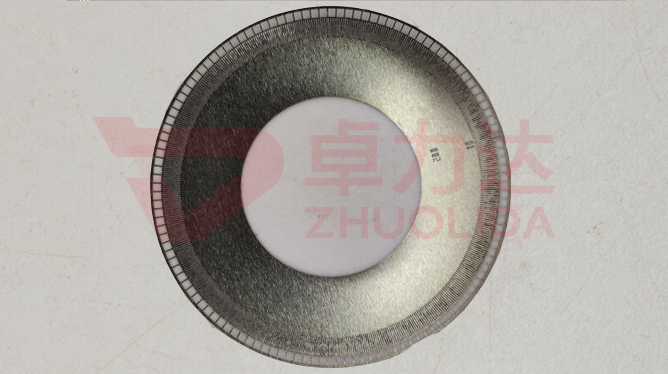
A 25 μm electroformed screen passes aperture and position checks, yet after a few days on the machine a hairline crack opens along the inside of the frame; the fault is usually not in the mesh but in the binding. Electroformed screen frame binding process governs how the thin foil joins the frame: whether the AB adhesive layer is even, how much of the 10–55 N tension survives once the clamps come off, and whether the folded corner cuts a stress riser into the sheet. It is logged separately from ±3 μm aperture accuracy — a true mesh still loosens at the edge the moment it meets a vibratory screener if the frame cannot carry the load. The trade checks bond reliability through tension in the framed state, holding lot variation within ±1 N, and foils of 15–30 μm are the ones most easily scored during release and folding.
Three failures dominate on the line. The first is debonding: a lot of 40 μm sheets leaves at 38 N bonded into AB adhesive frames, sits a month in the customer's stores, then goes on the machine with the corner adhesive gone white and lifting, tension down to 29 N and the cut size drifting on the spot. The second is edge collapse: folding presses a crease into the mesh, and once the flange is clamped the crease cracks first, the vision system tracing the split along the web at ≥50 μm spacing. The third is false tension: the jig reads 50 N, but the sheet springs back to 42 N after unclamping, the operator assumes the mesh is tight when it is not, and the rotary screener hums as soon as it starts. None of these appear in a ±3 μm aperture report or a ±0.002 mm roundness report, and by the time they surface mesh and frame are usually scrapped together. Electroformed screen frame binding process is harder than plain tensioning because adhesive, folding and springback all have to be managed together.
Parameter Window
• Framing tension: 10–55 N in bands, re-checked after unclamping, variation ≤ ±1 N
• Sheet thickness: 15–200 μm; foils under 30 μm are annealed before folding
• AB adhesive frame: bond-line thickness and cure time-temperature logged per lot, no starved corners
• Fold radius: inside transition scaled to sheet thickness to avoid a stress riser
• Position accuracy ±7 μm and aperture accuracy ±3 μm, measured before and after tensioning
• Nickel alloy hardness 450–550 Hv; trial-bend the edge when hardness runs high
Manufacturing Process (8 Steps)
1. Artwork preparation — leave generous binding allowance outside the aperture pattern, flag fold line and tension band.
2. Pre-treatment — substrate cleaning and conductive coating, mandrel passivation so strike nodules do not reach the edge.
3. Lamination and LDI — 8 μm/8 μm resolution and ±5 μm double-side alignment; the edge resist profile is set here.
4. Development — control concentration and time so neither hole walls nor the edge keep residue.
5. Electroforming — staged current density of 1–4 A/dm² with the bath held, keeping edge stress down.
6. Release and anneal — one-piece lift-off then low-temperature annealing so the edge relaxes before folding.
7. Binding and tensioning — AB adhesive applied, edge folded, jig tensioned to 10–55 N, tension re-checked after unclamping.
8. Inspection and packing — checker for openings, vision and flash measurement for position, pull test sampling bond strength.
Core Advantages
1. Reliable bond — electroformed screen frame binding process links shape-setting, adhesive and folding in one line, so debonding falls off sharply.
2. No false tension — re-checked after unclamping before shipping, one of the 10–55 N bands locked, so the customer does not re-verify on receipt.
3. Thin foils do not sag — 15–30 μm sheets are annealed before folding, so no crease forms at the corner.
4. Dimensions and bond tracked apart — aperture to the checker, tension and bond strength to the pull rig, so a fault pins to a bath run.
5. Traceable lots — adhesive lot, cure curve and tensioning curve archived per sheet, so a query is not settled from memory.
6. Faster changes — quick-change screen sets need no re-gluing or levelling at mounting, and downtime shortens.
Typical Applications
1. Battery-material vibratory screeners, where a loosened thin-mesh binding pushes particle size out of spec at once.
2. Pharmaceutical powder rotary screeners, where a frame gap traps product and contaminates the next batch.
3. Food and chemical quick-change sets, where AB adhesive frame tension consistency sets the line takt.
4. Precision screening of semiconductor abrasives, where the edge of a micro-hole sheet fears a crease most.
5. Large 610×660 mm decks, where tension is harder to distribute around a long perimeter.
6. Quick-change modules in stacked screen decks, where one loose sheet pulls the whole stack off tension.
Design and Selection Notes
1. Set binding allowance from sheet thickness first; do not skimp on foils under 30 μm.
2. Anneal before folding; if release stress is not relieved, the folded edge will lift.
3. Cure the AB adhesive to its time-temperature curve; uneven shrinkage pulls local dents into the mesh.
4. Scale the fold radius with sheet thickness; one die cannot cover the whole 15–200 μm range.
5. Tension must be re-checked after unclamping; a jig reading is not a delivered value.
6. Never mix tension bands in a lot, keep the ±1 N internal limit, or screener amplitude will not match.
7. Sample tension by zone on large decks; log all four corners as well as the centre.
Seen on its own, electroformed screen frame binding process barely occupies a standalone step: the nickel stress grows as it will in the bath, release and low-temperature annealing decide whether the edge springs back, the AB adhesive cure curve decides how long the bond lasts, and the re-check at unclamping gives the only true tension. Pre-treatment, exposure, deposition, stripping, folding and tensioning each own a stretch, and let any one slip and 10–55 N is just a number on paper. What is hard on a line is not turning out one tight sheet now and then, but keeping a dozen sheets from one bath and several consecutive lots inside the same band for both post-unclamp tension and bond strength — only then does ±3 μm aperture accuracy mean anything. For orders with hard requirements on quick change and long vibration runs, fix anneal time-temperature, bond-line thickness, fold radius and tension band into the process card at sampling stage and run to that card; it is far cheaper than re-gluing and re-tightening flanges after mounting. On paper electroformed screen frame binding process is two strings of parameters, tension and adhesive; on the line it is the simple fact that the frame is still tight and the edge has not sagged after months of running.
Contact:赖先生
Phone:+86 18938693450
Tel:0755-2708-8292
Email:yw9@zldsmt.com
Add:深圳市宝安区福永镇新和村福园一路华发工业园A3栋
 Zhuolida