Welcome: Shenzhen Zhuolida Electronics Co.TD
Language:
 ∷

∷
∷
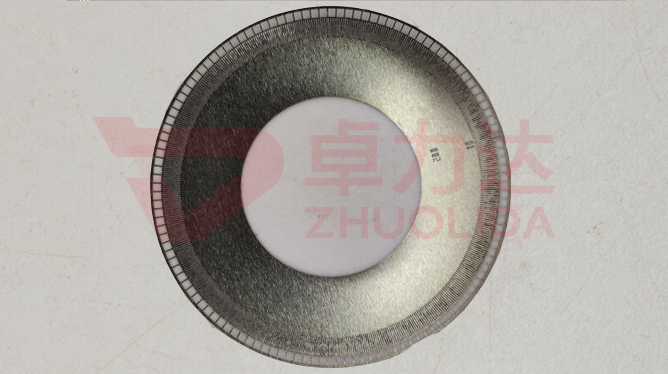
Open area of a sieve mesh is the share of total sheet area taken up by the effective openings of all its holes. One end of that number ties to filtration flux — higher open area, more material through per unit time; the other ties to sheet strength — the fuller the holes, the thinner the ligaments, and the easier tension and pressure differential bulge or crack the mesh. Electroformed sieve mesh open area control computes the theoretical value from hole diameter, pitch and layout, then uses electroforming to keep walls straight and ligaments on width so the as-built open area hugs the design instead of looking good only on the drawing. It is the same geometric ledger as micro-hole aperture tolerance ±3μm and sieve roundness ±0.002mm: stretch a hole or neck a wall in and the effective area moves with it.
Flux that falls short is usually not miscalculated but built crooked. One classification sieve computed enough theoretical open area yet would not pass the rated flow after installation; stripped, its walls were tapered, wide at the mouth and narrow at the base, so the effective opening was a size smaller than designed. With a thicker lot, the sheet bulged under 40N tension and pressure differential, pitch was pulled out of square and the cut point drifted — while a single-point aperture remeasurement still sat inside ±3μm. More hidden was developer undercut: ligaments eaten a few tenths of a micron thinner made open area read flatteringly high, then cracked from the ligament root after a few thousand cycles. None of these show up in single-point aperture gauging; they appear only when the whole effective opening area is scanned. Electroformed sieve mesh open area control is hard because it governs a cumulative quantity across an entire face.
Parameter Window
• Open area computed from hole diameter and pitch, held within ≤2% of design internally
• Minimum hole ≥25μm, pitch ≥50μm; ligament width directly sets sheet strength
• Micro-hole aperture tolerance ±3μm, sieve roundness ±0.002mm
• Position accuracy ±7μm; cumulative layout error drags down effective open area as a whole
• Optical-stop ligament linewidth 20μm-class fine ligaments, thickness chosen by pressure class
• Tension 10–55N (±1N internal); higher open area takes the low band against bulging
Manufacturing Process (8 Steps)
1. Data and drawing — set hole diameter, pitch and layout from the mesh count, compute theoretical open area first.
2. Pretreatment — clean and conductivize the base, passivate the mandrel face so plating starts without pinholes.
3. Lamination and LDI — 8μm/8μm resolution, double-side alignment ±5μm; hole shape and ligament width take form here.
4. Developing — control concentration and time, no undercut and no ligament thinning, so open area does not read falsely high.
5. Electroforming — current density 1–4A/dm² in stages, walls straight and ligaments on width.
6. Demolding — peel the whole sheet from a low-stress corner, fine ligaments not pulled out of square.
7. Inspection — imager and flash gauge scan hole diameter and position, image method remeasures effective open area.
8. Mounting and packing — aluminum frame bonded with AB adhesive, tension set in 10–55N steps before shipment.
Core Advantages
1. Predictable flux — hold electroformed sieve mesh open area control to design and no repeated pressure trimming after installation.
2. No strength sacrificed — open area and ligament width computed together, so fine ligaments still carry tension.
3. Size and area managed apart — ±3μm goes to the imager, effective open area to image-method remeasurement.
4. Straight walls — fewer tapered holes, effective opening not a size smaller than designed.
5. Honest life — ligaments on width, so bulging and cracking come later.
6. Traceable — each sheet records hole diameter, pitch and computed open area for bath-run lookup.
Typical Applications
1. Precision sieves for semiconductor material classification, where flux and cut accuracy both rest on open area.
2. 4–12 inch WLP ball-drop templates, of the same lineage in micro-hole packing density.
3. ABF substrate Ball and Flux plates, where opening share affects deposit volume.
4. Electroformed sieves for new-energy powder filtration, where strength matters under high pressure differential.
5. Composite plates with stiffeners or local thickening, where area and strength must be balanced together.
6. Large-format grids such as photovoltaic stencils, where whole-sheet open-area uniformity drives consistency.
Design and Selection Notes
1. Back out open area from flux first, then check strength with ligament width — do not stare at one number alone.
2. Do not loosen hole tolerance — let ±3μm drift one lot and cumulative effective area shifts.
3. Do not rush developing — a few tenths of a micron of undercut thins ligaments and inflates open area.
4. Build fine ligaments at the 20μm linewidth class; raise thickness one step for high pressure differential.
5. Remeasure sieve open area by image method scanning the whole sheet; a single-point aperture gauge cannot give total area.
6. Set tension in 10–55N steps; higher open area takes the low band.
7. Watch roundness ±0.002mm alongside it — a stretched hole changes effective area too.
Taken apart, electroformed sieve mesh open area control lives in no single step: LDI and developing fix hole shape and ligament width, an extra bite of developer undercut or a slight neck-in of the plated wall shifts the whole effective area, and demolding pulling fine ligaments out of square shifts it again. Pretreatment, exposure, deposition and peeling each guard one stretch, and if any loosens the design value is just a number on paper. Open-area remeasurement binarizes the whole sheet, computes the share from effective-opening pixels, reads nine points in classes across one sheet, stays clear of the 10mm stretched zone at the frame edge, and rejects outright any sheet beyond 2% deviation so it never slips into a good lot. What is hard is not making one sample that meets flux, but keeping a dozen sheets from one bath and several consecutive lots in the same as-built open-area class — only then do ±3μm hole tolerance and ±0.002mm roundness connect. For orders with hard requirements on both flux and strength, fix hole diameter, pitch, target open area and develop time in the process card at the sampling stage and scan whole sheets by image method in production; that is far cheaper than trimming pressure differential and swapping meshes after installation. On paper electroformed sieve mesh open area control is one percentage; on the line it is every sheet passing material cleanly through the same ligament width.
Contact:赖先生
Phone:+86 18938693450
Tel:0755-2708-8292
Email:yw9@zldsmt.com
Add:深圳市宝安区福永镇新和村福园一路华发工业园A3栋
 Zhuolida