Welcome: Shenzhen Zhuolida Electronics Co.TD
Language:
 ∷

∷
∷
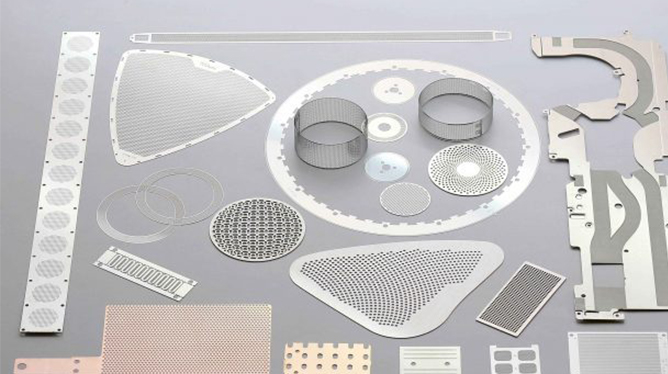
Shaped structural parts are the irregular, thin-walled metal components: spring contacts with cantilevers, locating plates with micro-teeth, frame parts that follow narrow slots, miniature pieces carrying several steps at different heights on one sheet. What they share is complex geometry in modest volumes, tight dimensions in difficult material. Stamping, CNC machining, and etching each hit a wall on them, for different reasons.
Stamping fears tooling cost. A precision progressive die starts at tens of thousands, and every geometry change means reworking it — a few thousand pieces cannot absorb that. Burrs and rollover from thin-stock blanking are unavoidable too, and deburring is manual work that ruins the thinnest parts most easily. CNC holds tolerance without trouble, but thin walls cannot be clamped — clamping alone distorts them, and cutting force on a 0.05 mm wall will push the part out of shape, while complex profiles stack up cycle time quickly. Etching handles complex two-dimensional outlines without burrs, but it only produces uniform thickness, so steps, relief, and local thickening are out, and undercut thins narrow ligaments and rounds sharp corners. Electroforming sidesteps all three: the profile comes from the mandrel so no stamping die is needed; the metal grows rather than being cut so thin walls keep their shape; thickness is controlled by deposition time so local thickening, steps, and relief are possible, and narrow slots and sharp corners replicate faithfully.
Demand for precision spring contacts and miniature structural parts has grown alongside miniaturization in consumer electronics and medical devices. Connectors get denser, contacts get smaller, and contact force still has to hold. MEMS and sensor packaging calls for metal structures with cantilevers. Microfluidic chips routinely use electroformed molds and channel inserts. These jobs run from a few hundred to tens of thousands of pieces and the geometry is revised often — exactly the band where electroforming pays. A shaped electroformed structural part needs no new die for each revision; the master changes instead, which puts the cost and the time where they matter.
Parameter Window
• Thickness: 5–200 µm; thin walls down to the low teens of microns
• Minimum feature: 10 µm; sharp corners and narrow ligaments replicate
• Minimum slot width: 15 µm, holding straight walls even when deep
• Profile tolerance: ±5 µm; tighter on critical mating faces
• Common materials: electroformed nickel, nickel-cobalt, copper, hardness adjustable
• Surface roughness: Ra < 0.2 µm, no post-polishing required
Manufacturing Process (8 Steps)
1. Master fabrication — build the master to the profile; sharp corners, narrow slots, and steps are defined here once.
2. Conductive treatment — a conductive layer ensures even plating across complex geometry.
3. Electroforming — control current and additives, managing internal stress as the metal fills.
4. Local thickening — extend deposition in selected areas to create steps and reinforcement.
5. Demolding — slow release, with particular care around thin walls and cantilevers.
6. Stress-relief flattening — low-temperature anneal releases stress and stabilizes dimensions and elasticity.
7. Inspection — check profile, thickness, flatness, and spring rate; reject distorted parts.
8. Surface finishing — plating, passivation, or selective insulation per assembly needs.
Core Advantages
1. No tooling cost — replication from a master; a revision changes the master only, so low volume works.
2. Burr-free edges — formed in one step with no flash, eliminating the fragile deburring operation.
3. Thin walls hold shape — no cutting force, so walls of a dozen microns stay true.
4. Three-dimensional freedom — steps, relief, and local thickening on the same sheet.
5. Faithful complex profiles — sharp corners, narrow ligaments, and re-entrant shapes survive without undercut distortion.
6. Tunable properties — material and process adjust hardness and spring rate for contact duty.
Typical Applications
• Connector spring contacts — small size, stable contact force, long mating cycles.
• MEMS and sensor structures — cantilevers, diaphragms, and support frames in one forming step.
• Optical module parts — lens barrel spacers and light shields, thin and profile-accurate.
• Medical device components — micro blade substrates, filter frames, implantable structures.
• Microfluidics and mold inserts — high-aspect-ratio channels and fine cavities.
• Precision instrument springs — consistent elasticity suited to volume assembly.
Design and Selection Points
1. Keep the profile on one master where possible; splitting into parts and assembling adds stack-up error.
2. Do not take ligament width below one third of sheet thickness, or demolding and handling will damage parts.
3. Leave a minimum radius at internal sharp corners; a square corner on the master concentrates stress after replication.
4. For parts that must flex, state the spring direction and deflection so material and heat treatment are set together.
5. Where steps or local thickening are needed, specify step height and transition; abrupt steps accumulate stress.
6. Parts with tight flatness requirements need a leveling or vacuum-chuck step — do not assume electroforming comes out perfectly flat.
7. Mark areas that will be welded or plated later; secondary processing on a nickel matrix has its own rules.
Precision shaped part electroforming follows a simple principle: replicate instead of cut, use a master instead of a die. The tooling cost of stamping, the clamping distortion of CNC, and the uniform-thickness limit of etching all fall away — complex profiles and thin walls grow in one step with edges clean enough to skip deburring. A shaped electroformed structural part is also flexible on volume: hundreds of pieces or tens of thousands both work, and a revision does not mean starting over. As products get smaller and geometries change more often, this forming route only becomes more cost-effective. Judging a precision shaped metal part still comes down to three things: profile fidelity, thin walls that do not collapse, and batch-to-batch consistency.
Contact:赖先生
Phone:+86 18938693450
Tel:0755-2708-8292
Email:yw9@zldsmt.com
Add:深圳市宝安区福永镇新和村福园一路华发工业园A3栋
 Zhuolida