Welcome: Shenzhen Zhuolida Electronics Co.TD
Language:
 ∷

∷
∷
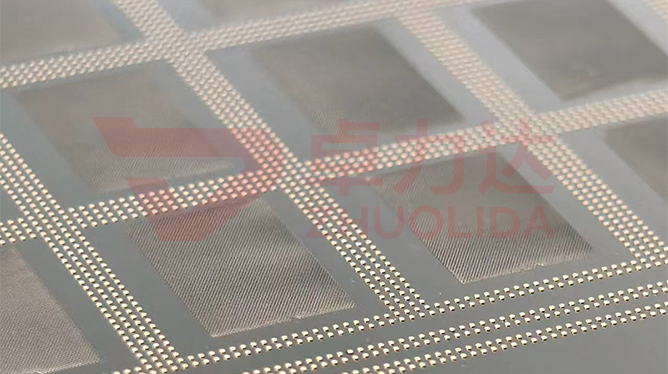
How many prints a stencil survives used to live in the operator's memory: when the stroke starts to feel draggy, release begins to tail and wiping gets more frequent, the sheet is swapped. Electroformed stencil print-life validation turns that judgement into a curve you can repeat — run continuous prints on a cycling rig at real squeegee pressure, print speed and release settings, stop at fixed intervals, and measure how far tension has fallen, whether ±7 μm position accuracy and ±3 μm aperture accuracy have drifted, and whether the walls still hold paste, until one metric crosses its line. What it delivers is not a nominal 15,000-cycle figure but an end-of-life criterion: which sheet, at which cycle, on which metric should come off the line. For chip-substrate orders where one stencil must cover a whole lot, that criterion matters more than the nominal life itself.
Without cycling data, life arguments go nowhere. Two sheets from the same bath: one still holds tension inside its band at 15,000 cycles, the other grows burrs at the aperture rim by 8,000 and the opening has widened by nearly 2 μm; trace it back and that sheet barely clears 450 Hv, the deposit is simply soft. Another lot drops to the bottom of its tension band at 6,000 cycles, the mesh rebounds slowly after the squeegee and release tails, and a vision re-check finds position already 5 μm out — yet the operator blames the paste lot and two jars get binned for nothing. The easiest misread is cleaning: one pass through the stencil washer and tension drops a band, most people call it foil fatigue, but sectioning shows the mesh is intact and it is the AB adhesive creeping under solvent and humidity because framing cure was never taken far enough. Mixed together, none of these can be pinned on deposition, framing or print settings by impression alone; electroformed stencil print-life validation exists to lay them out on one timeline.
Parameter Window
• Print-life target 15,000 cycles, with re-check points at 5,000 / 10,000 / 15,000
• Tension set in 10–55 N bands, ±1 N internal control; decay to the band floor triggers retirement
• Position accuracy ±7 μm and aperture accuracy ±3 μm, measured before and after cycling and compared item by item
• Stencil thickness 15–200 μm; foils under 30 μm relax more readily after cycling
• Nickel alloy hardness 450–550 Hv; at the lower bound, rim wear speeds up noticeably
• Wall roughness ≤ 0.01 μm; paste build-up drives more cleaning and shortens life indirectly
Manufacturing Process (8 Steps)
1. Sample logging — take sheets from one bath and record thickness, hardness, initial tension and a position baseline as the reference.
2. Incoming full check — automatic stencil checker for openings, vision and flash measurement for position, baseline data archived.
3. Framing for test — aluminium frame bonded with AB adhesive, tension set within a 10–55 N band, uniformity checked by the nine-point method.
4. Cyclic printing — continuous runs on the printer at production squeegee pressure, speed and release distance, with no mid-run parameter changes.
5. Interval re-check — stop every 5,000 cycles for tension, position, aperture and wall condition, and plot the decay curve.
6. Cleaning intervention — wash at production frequency, log tension before and after, and separate adhesive creep from foil fatigue.
7. End-point decision — retire at 15,000 cycles or on the first metric excursion, then section for rim wear and wall paste build-up.
8. Lot archiving — file the decay curves, bath run and tension band together, and feed them back to deposition and framing process cards.
Core Advantages
1. A working criterion — tension, position and aperture excursions decide the end point instead of an operator's feel for when to swap a sheet.
2. Comparable lots — same bath, same tension band, same print settings, so a life gap traces back to a deposition run.
3. Early warning — the 5,000-cycle check already shows the decay slope, with no need to scrap a whole lot before looking back.
4. Creep told from fatigue — measuring tension either side of a wash keeps AB adhesive faults off the foil's record.
5. Grounded selection — 15,000-cycle orders take sheets from the upper hardness bound, short runs can relax it, instead of one blanket stock rule.
6. Defensible records — electroformed stencil print-life validation files curves, bath runs and wash logs together, so a complaint has something to stand on.
Typical Applications
1. Chip-substrate printing, where one stencil must cover 15,000 cycles with no mid-run swap.
2. WLP ball-placement templates for 4–12 inch wafers, where millions of openings put wall condition at the end point.
3. Ball and Flux stencils for ABF substrates, tensioned in different bands with decay curves logged apart.
4. BGA and Mini LED fine-pitch printing, where position drift triggers retirement before aperture wear does.
5. Large-format photovoltaic grid stencils, where tension uniformity under a long squeegee stroke sets life consistency.
6. Composite stencils with post height or local thickening, where wear concentrates at steps and needs its own check point.
Design and Selection Notes
1. Fix the tension band first. Never mix bands within one validation lot; sheets run in one of the 10–55 N bands are compared only within that band.
2. Do not set only an end point. If the 5,000-cycle check already shows half the decay, add checks to the later intervals.
3. Mirror production in the cycle. Curves mean nothing if squeegee pressure, speed and release distance differ from the line.
4. Log cleaning on its own sheet — solvent type, frequency and tension before and after — or creep and fatigue cannot be separated.
5. Choose hardness to suit. A 15,000-cycle order takes the upper end of 450–550 Hv rather than the lower edge to save cost.
6. Re-measure position on the same vision system with the same datum; instrument-to-instrument offset can swamp real drift.
7. Sample across the bath, not just one spot; edge and centre sheets deposit differently, so life cannot rest on a single sheet.
Done properly, electroformed stencil print-life validation audits more than the stencil — it reconciles deposition, framing and printing on one ledger. Tension that falls fast usually sends you back to AB adhesive cure or the low-temperature anneal; position that starts drifting after a few thousand cycles often means residual stress was never fully relieved; burrs at the rim first point at deposit hardness sitting on the lower bound. The figure 15,000 cycles is not remarkable on its own; what is, is a dozen sheets from one bath all reaching the end point along roughly the same curve, which is when ±7 μm position accuracy can honestly go on the delivery note. For orders with a hard life figure, fix the tension band, re-check intervals and wash frequency into the validation card at sampling stage and audit to that card in production — far less trouble than chasing tailing on the line sheet by sheet. On paper electroformed stencil print-life validation is a set of curves; on the line it is simply that every sheet has a defensible cycle at which it comes off.
Contact:赖先生
Phone:+86 18938693450
Tel:0755-2708-8292
Email:yw9@zldsmt.com
Add:深圳市宝安区福永镇新和村福园一路华发工业园A3栋
 Zhuolida